

As the world’s urban population hurtles toward 7 billion by 2050, cities stand at a crossroads: become engines of planetary healing or drivers of ecological collapse. The old model—sprawling, resource-hungry, and wasteful—is no longer tenable. The only viable path forward is a radical reinvention: dense and green cities that embed the circular economy at their core. Singapore’s transformation from a fishing village to a global sustainability powerhouse shows what’s possible, but the clock is ticking for the rest of the world.
Design for Disassembly and Material Recovery: The End of Urban Waste
Every year, the world generates over 2 billion tonnes of construction and demolition waste—much of it dumped in landfills or incinerated, releasing CO₂ and toxins. In a circular city, this is unthinkable. Buildings must be designed for disassembly, turning today’s skyscrapers into tomorrow’s material banks.
- Modular Construction: Prefabricated, standardized parts can be easily removed and reused. Studies show modular building can reduce construction waste by up to 90% (World Economic Forum, 2022).
- Material Passports: Digital records track every component, making future recovery and recycling efficient. The EU’s Level(s) framework is pushing this across Europe.
- Urban Mining: Cities like Amsterdam are already “mining” old buildings for steel, copper, and rare materials, closing the loop and slashing demand for virgin resources.
Urgency: By 2030, global construction is set to double. If we don’t embed disassembly now, we lock in waste and emissions for generations.
Selecting Low-Embodied-Energy and Renewable Materials: Building Without Borrowing from the Future
Renewable and recycled materials, such as sustainably sourced timber and recycled bricks, are preferred for their lower embodied energy and positive contribution to the circular economy43. Integrating these materials into vertical and green urban projects supports long-term sustainability and resource efficiency.
| Material | Embodied Energy (MJ/kg) | Sustainability Considerations |
| Concrete | 0.8 – 1.5 | High CO₂ emissions in cement production |
| Steel | 20 – 50 | Energy-intensive, but highly recyclable |
| Aluminum | 100 – 200 | Extremely energy-intensive, recycling crucial |
| Timber | 2 – 5 | Low embodied energy, renewable if managed |
| Recycled Brick | ~0.1 – 0.3 | Very low embodied energy, promotes circularity |
The built environment accounts for nearly 40% of annual global CO₂ emissions (GlobalABC, 2023). Much of this comes from the “embodied energy” in materials like concrete and steel.
- Sustainable Timber: Cross-laminated timber (CLT) stores carbon and can cut embodied emissions by 60% compared to concrete.
- Recycled Materials: Using recycled steel saves 75% of the energy versus new steel; recycled concrete can halve emissions.
- Biophilic Integration: Green roofs and living walls use renewable, living materials that regenerate themselves, while cooling cities and cleaning air.
Data Point: Singapore’s vertical greenery absorbs up to 10,000 tonnes of CO₂ annually—equivalent to taking 2,000 cars off the road (National Parks Board, Singapore).
Urgency: The next decade will see enough urban construction to build another New York City every month. Our material choices now will define the planet’s future.
Resource Loop Closure: Energy and Water—Cities as Living, Regenerative Systems
Cities consume 75% of global resources and produce 50% of all waste (UNEP, 2023). A dense and green city must function like a forest: nothing wasted, everything reused.
- Energy: Singapore’s “City in Nature” vision integrates solar panels with green roofs, creating microgrids that power neighborhoods sustainably. Studies show that green roofs can reduce building energy use by up to 25%.
- Water: Permeable pavements, rain gardens, and urban wetlands capture and filter stormwater, reducing floods and recharging aquifers. Singapore reclaims 40% of its water through advanced treatment—a global benchmark (PUB Singapore).
- Organic Waste: Composting urban greenery and food scraps can replace chemical fertilizers, close nutrient loops, and cut methane emissions from landfills.
Urgency: Climate change is intensifying droughts and floods. Without circular water and energy systems, cities will face chronic shortages and deadly disasters.
Digitalization and Stakeholder Collaboration: Orchestrating Urban Complexity
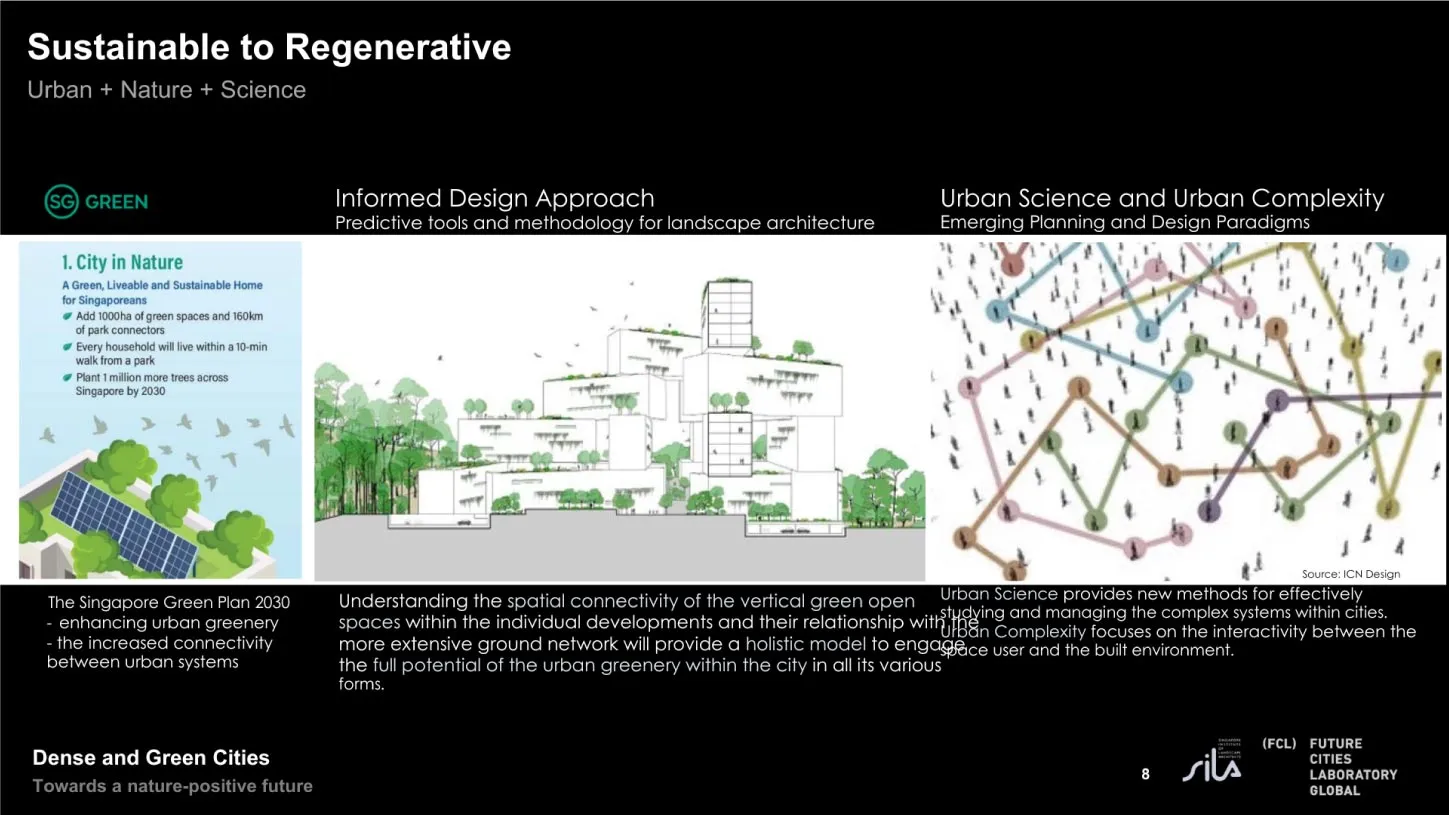
Dense and green cities are complex ecosystems. Only digitalization and radical collaboration can manage this complexity and unlock circular potential.
- Urban Digital Twins: Real-time 3D models simulate energy, water, and material flows, enabling predictive maintenance and rapid response to crises.
- Material Banks: Digital platforms like Madaster in the Netherlands catalog building materials citywide, facilitating reuse and circular procurement.
- Community Engagement: Singapore’s placemaking initiatives show that involving citizens in design and stewardship increases green space use and reduces vandalism.
Data Point: McKinsey estimates that digitalization could reduce urban infrastructure costs by 15% and cut emissions by 20% (McKinsey, 2023).
Urgency: Without digital tools, cities risk chaos, inefficiency, and public disengagement. The time to build these systems is now.
Monitoring, Policy, and Finance Mechanisms: Scaling Circularity Before It’s Too Late
Circular cities need more than vision—they need relentless measurement, bold policy, and massive investment.
- Performance-Based Regulation: Singapore’s Green Mark and Europe’s Level(s) frameworks tie incentives to real-world outcomes, not just intentions.
- Green Finance: Global green bond issuance hit $500 billion in 2023, but the World Bank estimates we need $4.5 trillion annually to meet urban sustainability goals.
- Data-Driven Monitoring: Satellite and Internet of Things IoT networks track urban heat, air quality, and biodiversity, informing adaptive management.
Urgency: The window to avoid catastrophic urban lock-in is closing. Every dollar, policy, and project must drive measurable progress—starting today.
The Bottom Line: Cities Are the Frontlines of Planetary Survival
Dense and green cities are not a luxury—they are a necessity for human survival in the 21st century. The circular economy is the only model that can deliver prosperity without planetary collapse. Singapore’s journey proves what’s possible, but the world must move faster, scale bigger, and act with urgency.
The choice is stark: Will our cities become engines of regeneration, or relics of a failed, linear past? The time to decide is now.