
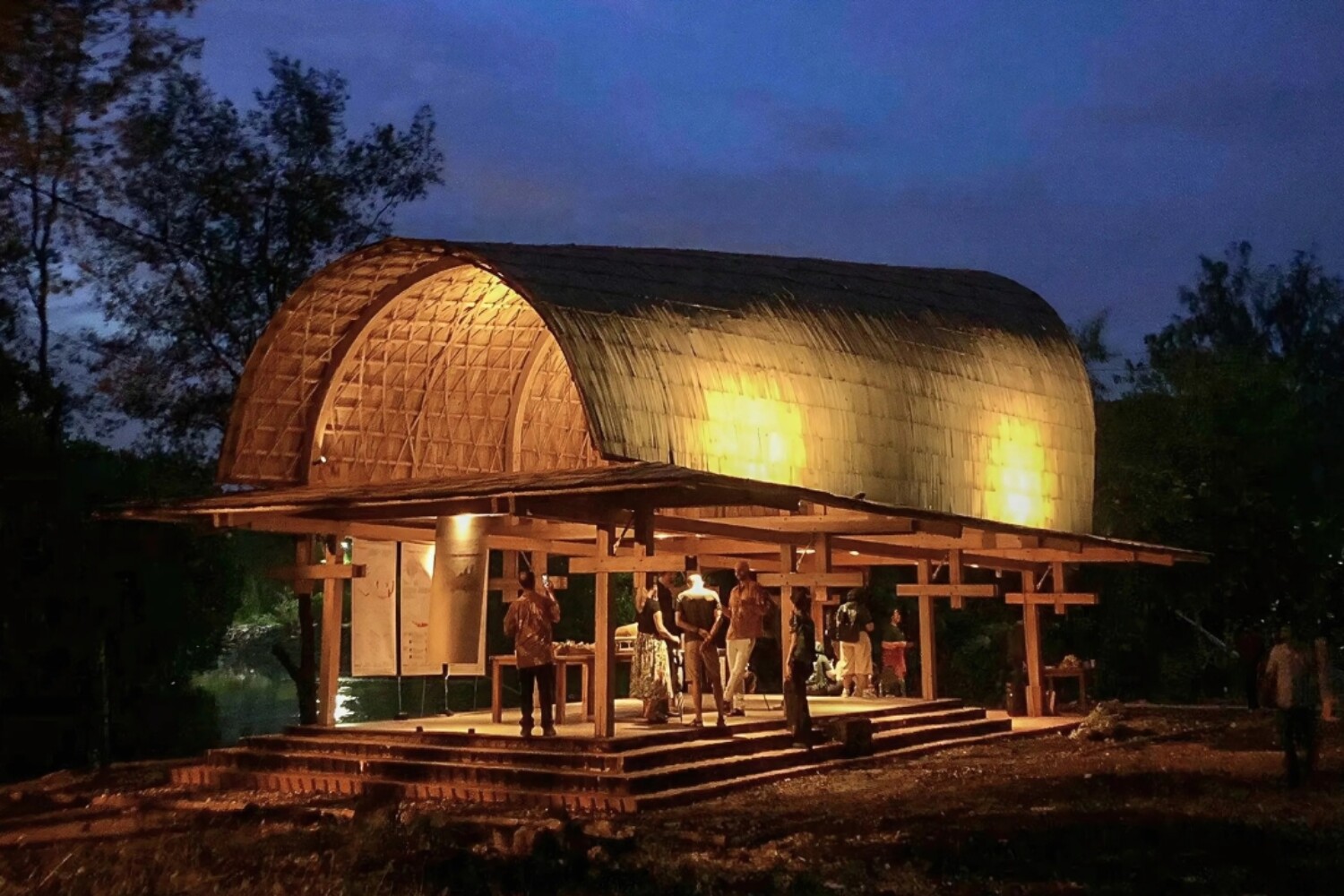
Construction accounts for nearly 40% of global CO2 emissions once you include building activity, materials production and transport. In Bali the pressure is visible at street level: nearly 70% of Denpasar has urbanised in the past 30 years, and local building materials have largely been replaced by carbon-intensive alternatives along the way.
For developers, the question is no longer whether to take embodied carbon seriously. It is how to know, with actual numbers, whether a design decision moves the needle.
The project
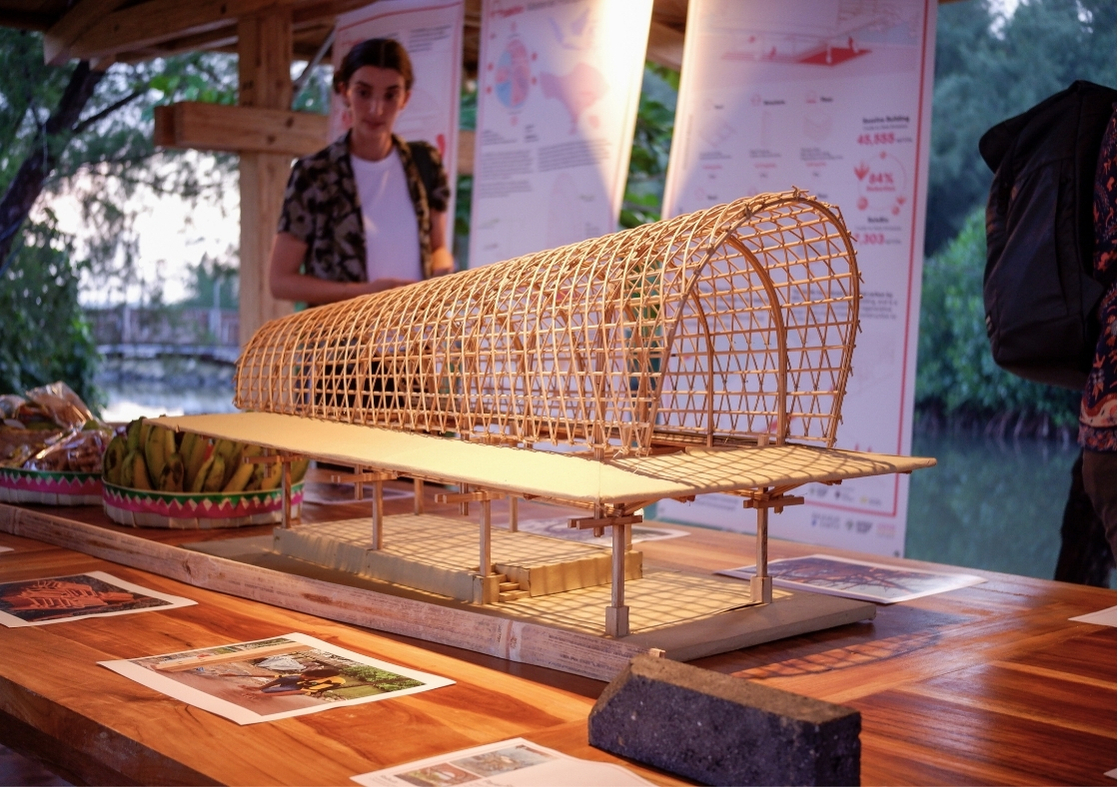
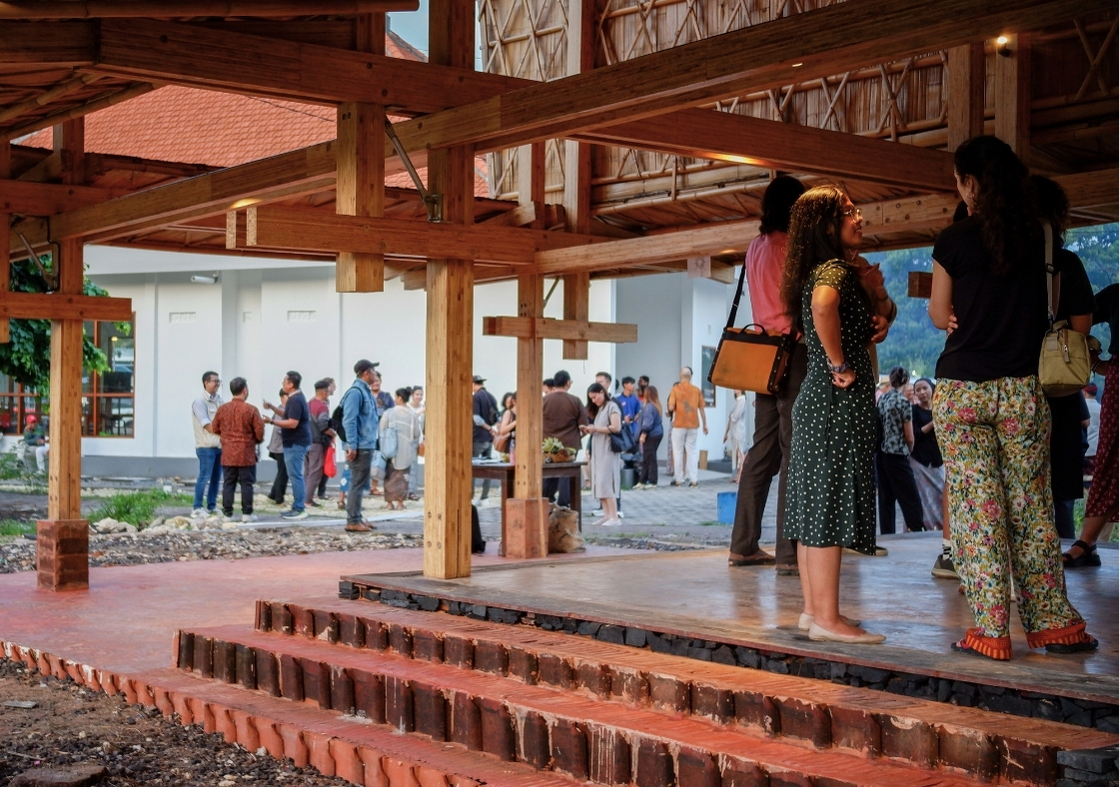
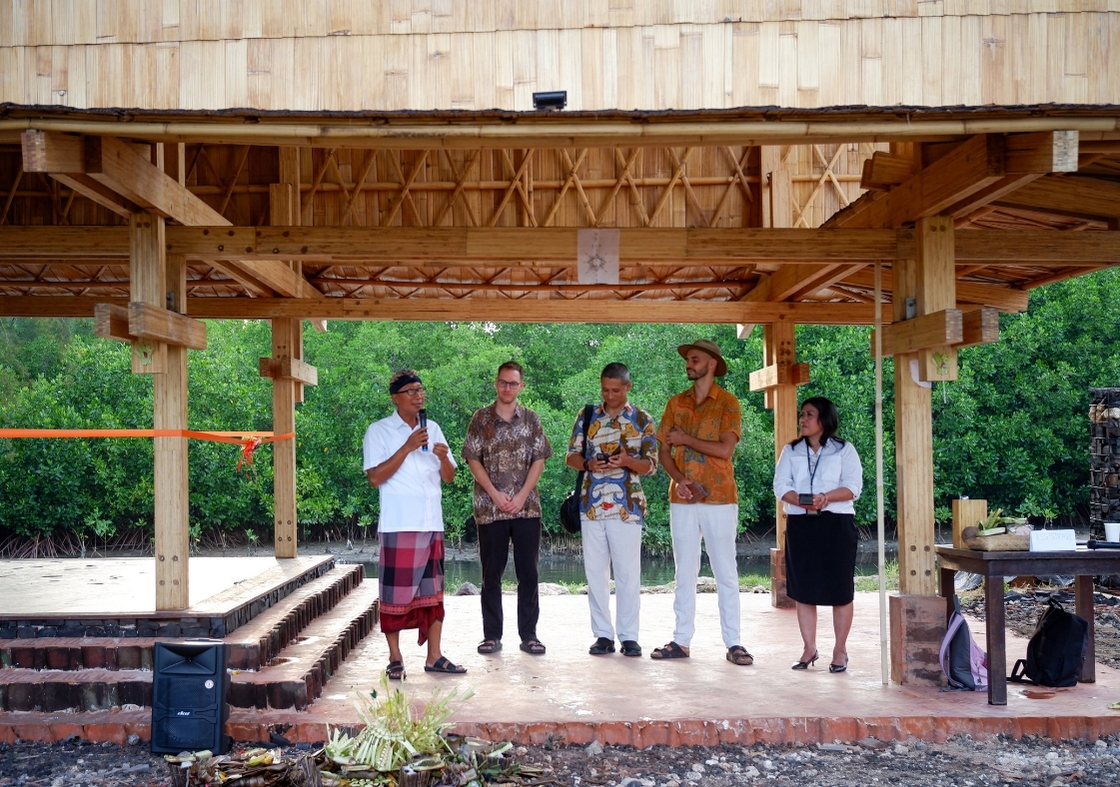
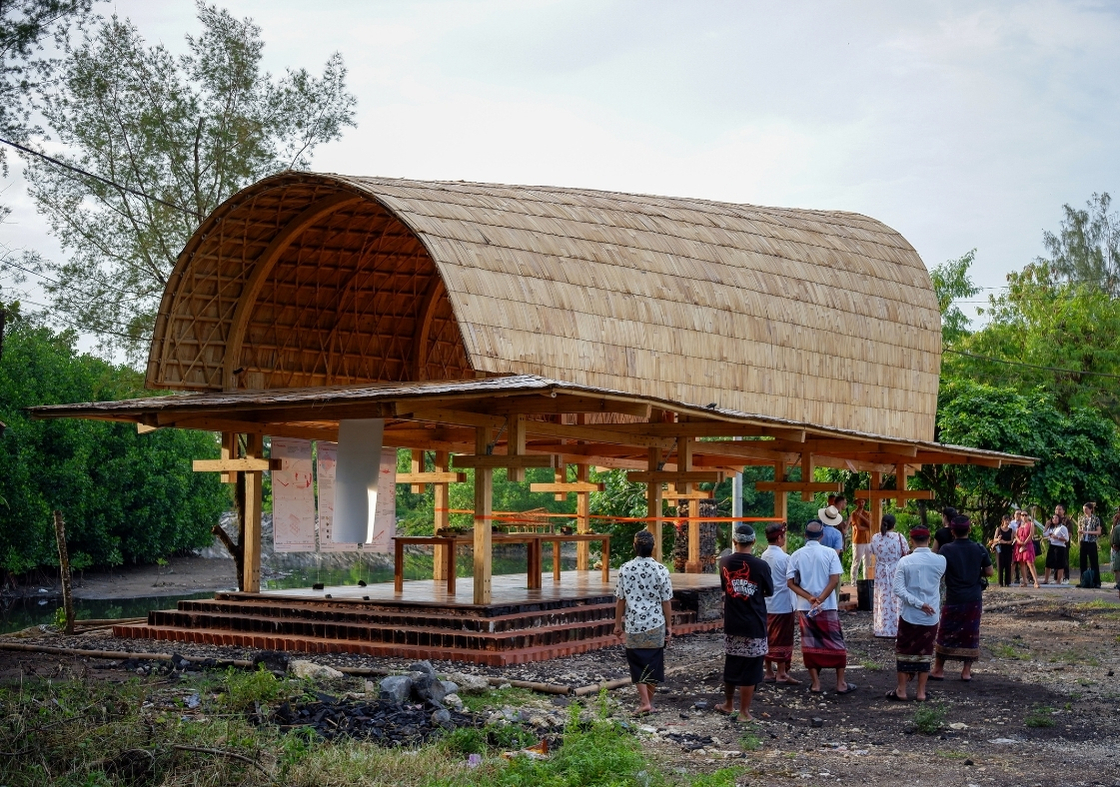
Bale Bio is an 84-square-metre pavilion at Mertasari Beach, rising 8.5 metres at its peak, developed through the Bauhaus Earth ReBuilt initiative. Its design draws on the Bale Banjar, the open-air meeting hall at the centre of Balinese village life. These structures were once built from timber and local materials. Most are now concrete.
The pavilion is the first building in Bali to use structural laminated bamboo. The material was grown by smallholder cooperatives in Flores, split and treated near the point of harvest, then laminated in Bali by indobamboo. Simpler bamboo forms — round poles, splits and pelupuh cladding — make up the rest of the structure.
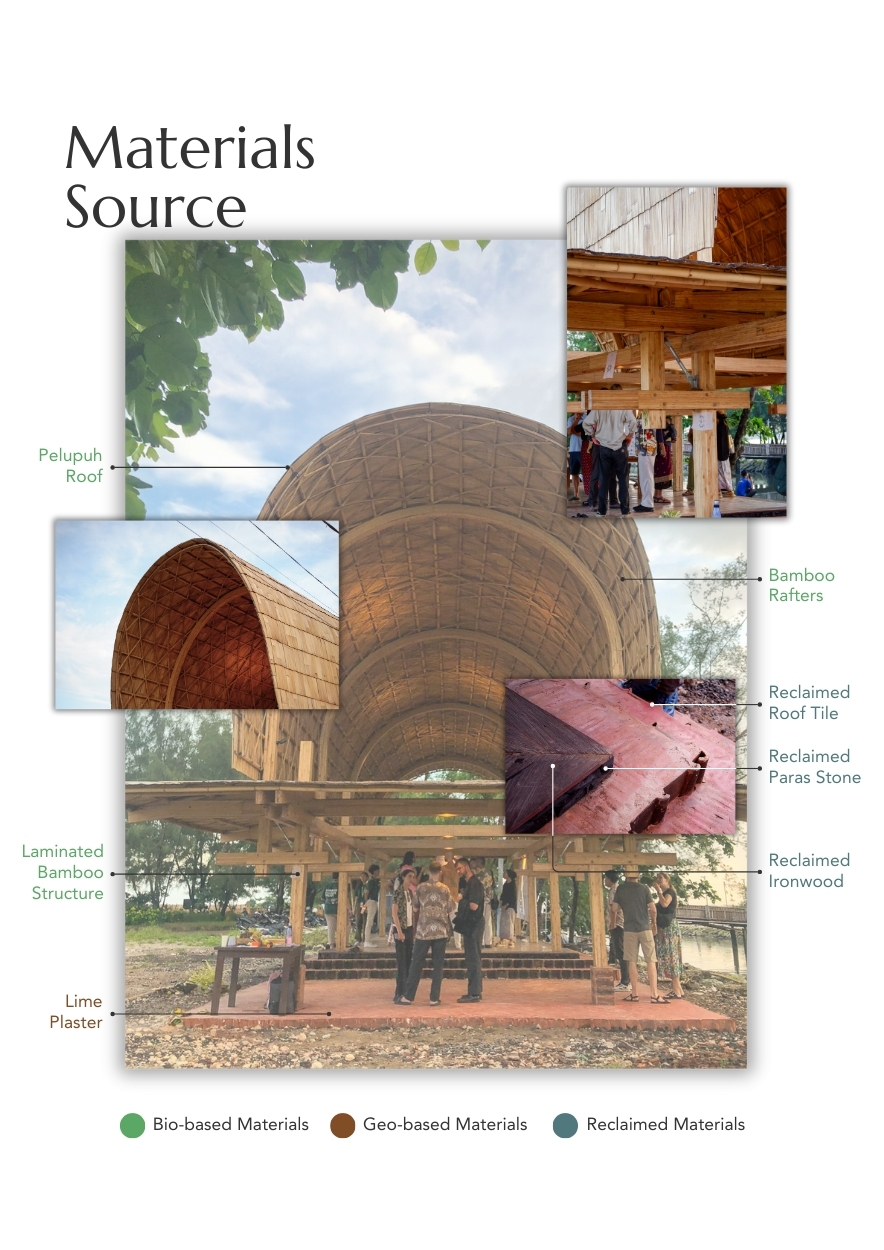
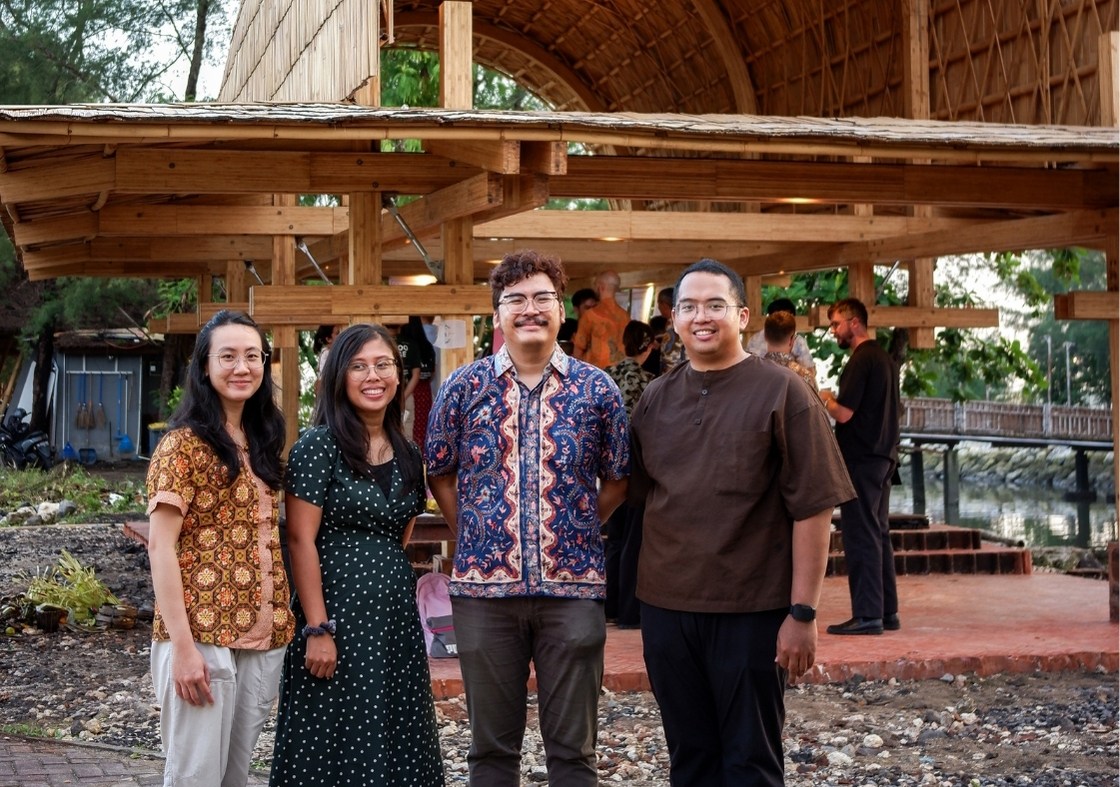
The project brought together Bauhaus Earth, Bamboo Village Trust, Kota Kita, Warmadewa University, Cave Urban, indobamboo, Atelier One and Eco-Mantra. Construction ran from September 2024 to February 2025.
What we measured
Eco-Mantra conducted the life cycle assessment for the pavilion, covering cradle-to-gate (Stage A) emissions: extraction, production, transport and assembly.
The assessment ran before and during construction. That timing mattered. Sustainability data could inform design decisions while they were still decisions, rather than becoming retrospective findings about choices already poured in concrete.
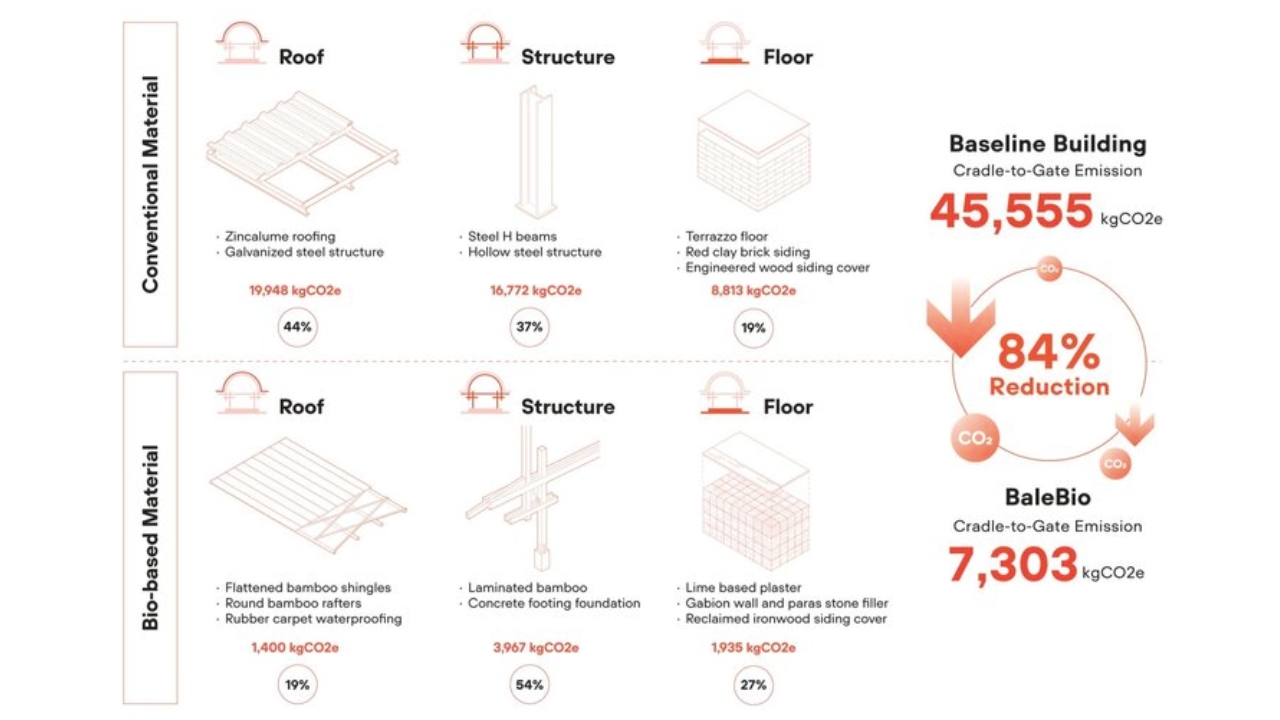
It also required original data work. Peer-reviewed emissions data for Indonesian bamboo barely exist, and the One Click LCA platform had no entries for Indonesian bamboo building products, so the team built its own inputs. Embodied emissions for bamboo culms and shingles were derived by combining an LCA of tali bamboo products with field research on carbon storage in Balinese bamboo stands. For laminated bamboo, which has no Environmental Product Declaration in Indonesia yet, the team used the EPD of a comparable product made with similar production techniques. Where Indonesian emission factors were unavailable, data were drawn from countries with a similar energy mix and production profile. A comparative review confirmed the discrepancies were minimal relative to the overall findings.
The result
The conventional baseline structure came to 51,336 kgCO2e. Bale Bio came to −2,062 kgCO2e.
That is a 104% reduction in cradle-to-gate emissions, accounting for biogenic carbon storage. The building stores more carbon than its production released.
The scope matters here. These are Stage A figures, and biogenic carbon is included without assumptions about end-of-life scenarios. Stages B, C and D are being assessed on an ongoing basis, supported by a maintenance manual developed post-construction.
What the assessment surfaced
The findings went beyond a headline number. The single largest emissions contributor turned out to be the carpet rubber waterproofing membrane in the roof, a detail that now informs maintenance planning, since future roof upkeep risks adding emissions unless lower-impact alternatives replace it.
Production emissions were dominated by the lamination process, offset by the bamboo’s carbon sequestration. The simplest bamboo components performed best environmentally because they required minimal processing. Concrete foundations added emissions but were judged essential for Bali’s climate.
The assessment also produced a path forward. The pavilion’s footprint could be reduced further by sourcing only domestic products, increasing the share of reclaimed materials and building elements, and finding substitutes for concrete foundations and footings.
This is what an LCA is for. Not a certificate at the end, but a working picture of where a building’s carbon actually sits, specific enough to act on.
What this means for a development
Bale Bio is a pavilion, not a resort. The value for a larger project sits in the method rather than the material.
Three things transfer. Running the assessment during design rather than after it is the first, because the numbers only change outcomes while the decisions are still open. The second is knowing which decisions carry the weight: on this project a roofing membrane mattered more than any headline material choice, and that is the kind of finding that only appears when someone measures. The third is being precise about what a figure covers. A carbon number without a stated scope is a claim rather than a measurement.
The Bale Bio findings were published in IOP Conference Series: Earth and Environmental Science as part of the Sustainable Built Environment Conference, Tokyo (Long et al., 2026).