
Date Published: September 4th, 2024
Written by: Vania Dian Gunawan, edited by Charlene Octavian
Several studies have shown that humans spend up to 90% of their time indoors, whether at home or in the office. But have you ever considered that the places where we spend most of our time might negatively affect us and the environment? The building industry is important to our well-being and the planet. As we continue to spend most of our time indoors, developers, architects, builders, and designers need to prioritize green building practices.
But what exactly makes the building green, and why should we care?
Unlike conventional buildings, a green building is ecologically conscious throughout its life cycle – from planning, design, and construction to operation, renovation, and demolition. It applies sustainable principles to enhance resource efficiency, maintain indoor air quality, use non-toxic materials, minimize environmental impact, and ensure occupant health.
So, what are the issues with conventional buildings that we have lived in, and what impacts might we have overlooked?
Problem with Conventional Building
1. Affecting well-being and productivity:
One of the causes is poor indoor air quality. Various pollutants can degrade indoor air quality. Building materials like plywood, asbestos, and pressed-wood products, can release formaldehyde and volatile organic compounds (VOC). VOCs easily evaporate at room temperature, irritating the eyes, nose, and throat, nausea, headaches, and harm to the neurological system, liver, and kidneys. Synthetic materials and chemicals often contain toxic elements.
2. Negatively affecting the environment:
-
High energy & water consumption:
This leads to increased costs and environmental impact. Heating, Ventilation, and Air Conditioning (HVAC) systems, which regulate indoor temperature for occupant comfort, account for 50% of the building’s energy consumption. High water consumption in conventional buildings is caused by inefficient plumbing fixtures, poor water management, outdated HVAC systems, lack of leak detection, non-water-efficient appliances, and inadequate maintenance.
-
The usage of non-sustainable resources:
Conventional building materials, such as bricks, steel, and concrete have significant negative environmental impacts due to the extraction and manufacturing processes. These materials are often used to maximize functionality and costs but typically end up in landfills and are not recyclable or biodegradable due to their chemical composition. Additionally, the materials used in conventional buildings often have a shorter lifespan, leading to more frequent replacements and further environmental impact.
3. Improper waste management can increase environmental pollution.
Besides the problems mentioned above, the buildings and construction sector are the largest contributor to greenhouse gas emissions, responsible for 39% of global emissions (28% come from operational energy use for heating, cooling, and powering, while the remaining 11% result from the materials and construction processes). So, the built environment sector is crucial in tackling the climate crisis, with an urgent need to address carbon emissions. That’s why green building practices are increasingly seen as the solution to mitigating these impacts.
To address these issues, green buildings are assessed through various categories that focus on reducing environmental impact. According to the Green Building Council Indonesia, here are the six assessment categories used to evaluate green buildings:
6 Assessment Category of Green Building:
1. Appropriate Site Development:
- Appropriate land use criteria focus on sustainable land management. Effective land use means not building on the entire area; for instance, 30% of the total land can be designated as infiltration areas and green spaces. This includes access to public facilities and transportation, green landscaping, minimized stormwater runoff, and careful site management to avoid harming the surrounding areas.
- The building should also be constructed to suit the different climatic conditions to achieve energy efficiency while also providing thermal comfort. This should be accomplished through proper design rather than relying on mechanical equipment. Mechanical systems should only be used when the weather conditions are unacceptable. this involves reducing energy usage during both construction and operation. Design strategies can maximize natural light to reduce electricity use during the day. Incorporating renewable energy sources such as solar panels or wind turbines, or the usage of energy-efficient appliances such as LED lights and AC inverters, can further enhance energy conservation.
2. Energy Efficiency and Conservation:
This involves reducing energy usage during both construction and operation. Design strategies can maximize natural light to reduce electricity use during the day. Incorporating renewable energy sources such as solar panels or wind turbines, or the usage of energy-efficient appliances such as LED lights and AC inverters, can further enhance energy conservation.
3. Water Conservation:
In construction, this means minimizing water waste. During building operations, water conservation can be done by monitoring, utilizing rainwater for later use, reusing water, installing infiltration wells, and using water-efficient appliances such as dual-flush toilets and low-flow valves in fixtures.
4. Material Resource and Cycle
This criterion ensures that building materials are reused or disposed of in an eco-friendly manner. Materials with a lower environmental impact like bamboo, recycled steel, and reclaimed wood, help reduce waste production and the depletion of natural resources.
5. Indoor Health and Comfort
This criterion focuses on the health and comfort of the building occupants that affect productivity. This includes ensuring enough natural light and the amount that can enter the building so it can be comfortable for the occupants, using noise-absorbing materials for better acoustic comfort, and selecting non-toxic materials.
6. Building Environment Management
This category includes innovations in building quality improvement, the availability of comprehensive building documentation, a dedicated team for maintaining green building principles, and thorough training in the operation and maintenance of green building aspects.
The Benefits of Green Building
-
Improving the quality of life:
Thoughtful planning, including natural ventilation, strategic openings, and the usage of non-toxic materials, enhances air quality, better circulation, and maximizes sunlight. This leads to healthier, better moods, and more productive building occupants.
-
Minimizing the negative impact on the environment:
Green buildings save water and energy, use eco-friendly materials, and implement sustainable practices. They lower carbon footprints by utilizing low-emission, locally sourced materials, which reduce transportation distances and support eco-friendly transportation options like public transport, walking, or biking.
-
Reducing operational and maintenance costs:
by conserving water and energy, green buildings lower utility expenses and reduce maintenance costs over time.
-
Building Durability:
High-quality materials help extend the lifespan and resilience of the building.
The main challenges to transitioning to green buildings include the need for more awareness, and skills, and the perceived higher initial cost compared to conventional buildings. However, other than the benefits mentioned above, as technology advances, and if there is an increase in adoption, market demand, and government incentives, green buildings could be more affordable. Training for architects, builders, and clients, along with supportive policies and regulations, is important to support the transition to sustainable design and green buildings.
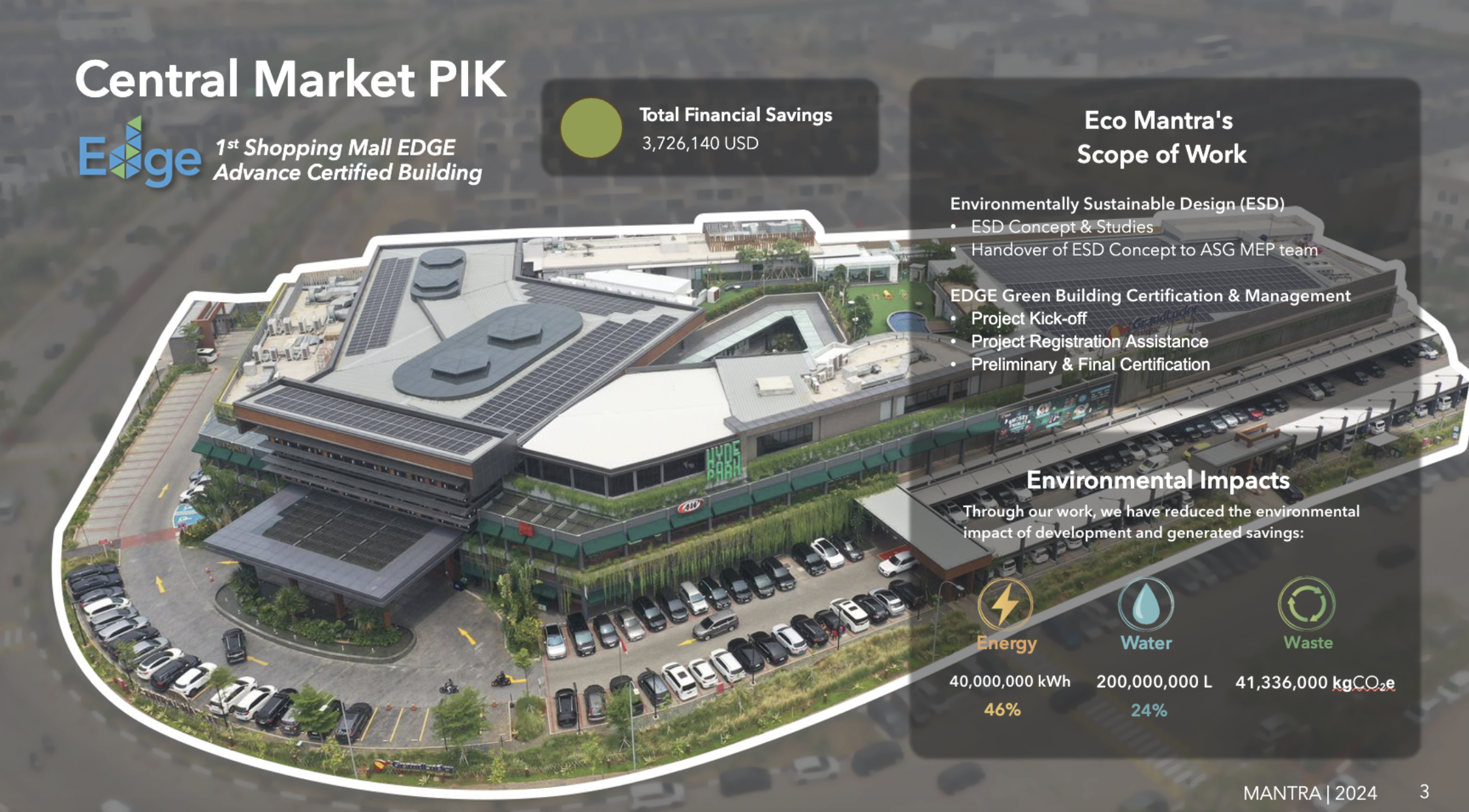
Eco-Mantra is an environmental engineering consultancy that collaborates with visionary leaders and developers to create eco-friendly destinations. We assist with green building certifications for projects such as Central Market PIK, Tetrapod Bali, and Orange Groves Cabin PIK. In particular, Central Market PIK stands out as the first eco-lifestyle hub in Indonesia to achieve EDGE Advanced certification. Click the link here to read more about Central Market PIK and the certification.
Sources:
Apa Saja 6 Kriteria Green Building dan Contohnya?
Beyond Conventional Construction, the Rise of Green Architecture
Conventional vs Green Building
Did you know we spend 90% of our time indoors?
Green Building: Pengertian, Kriteria Penilaian, dan Contohnya
Green Building vs Traditional Building: 4 Main Differences
How do green building materials affect indoor air quality and occupant health?
Penerapan Green Building di Indonesia