
Date Published: December 6th, 2024
Written by: Vania Dian Gunawan, edited by Charlene Octavian
Water Management
Water is essential for all life and the environment. It is needed for everyday activities like drinking, showering, industrial processes, and agriculture. However, water quality can degrade due to increasing population, industrialization, and climate change. Water management includes the careful and sustainable use and preservation of water resources to secure a sustainable future. It involves efficient practices in the use, collection, storage, and disposal of water. One important aspect of water management is wastewater treatment, which we’ll focus on in this article.
Wastewater Treatment
Wastewater treatment is equally vital for environmental sustainability. Wastewater, from human activities and rain runoff, must be treated to remove contaminants before being safely returned to the natural water cycle. However, over 80% of the world’s wastewater, and more than 95% in some developing countries, is released untreated. Additionally, 2.4 billion people lack access to better sanitation facilities. Only 26% of urban and 34% of rural sanitation services effectively prevent human contact with waste, meaning many areas lack proper wastewater management.
The Importance of Wastewater Treatment
Nature can handle small amounts of water waste, but it can’t cope with the billions of gallons of wastewater produced daily without treatment. Untreated wastewater poses serious environmental and health risks:
Health Impact
Untreated wastewater can spread harmful bacteria, viruses, and parasites, leading to illnesses like diarrhea, vomiting, and fever. It may also contain dangerous chemicals such as heavy metals and pesticides, which can cause severe health issues, including cancer and nerve damage. Proper treatment is crucial to remove these harmful substances and safeguard health.
Environmental Impact
Untreated wastewater depletes oxygen in water bodies, harming aquatic life and causing harmful algae blooms that damage marine ecosystems. It adds excessive nutrients like nitrogen and phosphorus, leading to eutrophication, which disrupts aquatic life by causing overgrowth of plants and algae. Additionally, the organic matter in wastewater clouds and discolors water, reducing light penetration and stunting the growth of aquatic plants.
Resource recovery
Wastewater treatment can help reduce water shortages by producing clean water that can be used for things like irrigation or industrial processes. This contributes to conserving freshwater resources and easing the pressure on existing water supplies.
Recreation and quality of life
Clean water enhances the quality of life and recreational opportunities. Many people choose their homes based on nearby water amenities, and activities like swimming, fishing, boating, and picnicking draw visitors. Effective wastewater treatment is essential for keeping these water resources clean and safe, preserving their value for both residents and visitors.
The Wastewater Treatment Process
The wastewater treatment process includes several key stages to remove contaminants and return clean water to the environment:
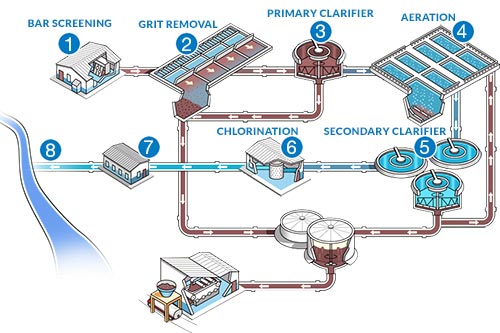 Source: Cole Parmer
-
Stage 1: Bar Screening
Large objects that could damage equipment or block water flow are removed using a bar screen. These items are filtered out from the incoming wastewater and sent to a landfill.
-
Stage 2: Screening
Wastewater flows through a grit chamber to remove small particles (grit) that could damage equipment. Various grit chambers—horizontal, aerated, or vortex—help settle the grit at the bottom, allowing clean water and organic materials to move on while the grit is discarded.
-
Stage 3: Primary Clarifier
In the primary clarifier, solids or sludge settle at the bottom of large tanks, separating 25%-50% of the solids from the water. Proper flow rates are essential: too fast, and solids won’t settle; too slow, and the process is disrupted. The settled sludge is regularly removed, processed, and often used as fertilizer.
-
Stage 4: Aeration
In the aeration tank, air is pumped to convert ammonia (NH3) into nitrate (NO3) and provide oxygen for bacteria to break down organic material. This process speeds up bacterial activity, improving decomposition. Aeration is achieved by either diffusing air into the tank or through agitation. Maintaining optimal oxygen levels is crucial, as levels below 2 ppm can harm bacteria. Monitoring dissolved oxygen, ammonia, and nitrate ensure effective treatment.
-
Stage 5: Secondary Clarifier
After aeration, the water flows into a secondary clarifier where fine solids, or activated sludge, settle at the bottom. This sludge, rich in bacteria, is partially returned to the aeration tank to enhance bacterial activity and breakdown of organic material, while the excess sludge is discarded. The resulting water has reduced organic material and should meet effluent standards.
-
Stage 6: Chlorination (Disinfection)
To prevent harmful bacteria from entering the environment, the treated water is tested and disinfected. Chlorination, the most common and cost-effective method, is used, though ozone and UV treatments are also options. If chlorine is used, it’s important to ensure the levels are safe before the water is released.
-
Stage 7: Water Analysis & Testing
Testing for pH levels, ammonia, nitrates, phosphates, dissolved oxygen, and residual chlorine is essential to ensure the treated water meets environmental standards and is safe for discharge. Continuous monitoring throughout the treatment process checks water flow, clarification, and aeration. Final tests confirm that the water complies with environmental standards.
-
Stage 8: Effluent Disposal
Once the treated water meets all permit specifications, it is safely reintroduced into the environment. This step ensures that the water is clean and meets discharge standards before being released.
Eco-Mantra’s Role in Wastewater Management
At Eco-Mantra, we recognize the importance of responsible wastewater management. By implementing the integrated water management system into our client’s properties, we aim to minimize the environmental impact and sustainable water use. For instance, at Waterbom Bali, we installed a Sewage Treatment Plant (STP) that converts wastewater into partially purified water suitable for irrigation, saving 1,305 m³ of water by the end of 2022.
Click here to learn more about our integrated water management system to see how we can help enhance sustainability in your projects.
Another example is a wastewater garden, a natural filtration system in Begawan Biji. This integrated water system purifies water naturally without heavy chemicals, minimizes water consumption, and offers additional benefits. Click here to see more details.
Sources:
Better sewage treatment critical for human health and ecosystems
The Importance of Wastewater Treatment: Protecting Our Environment and Health
The Wastewater Treatment Process