
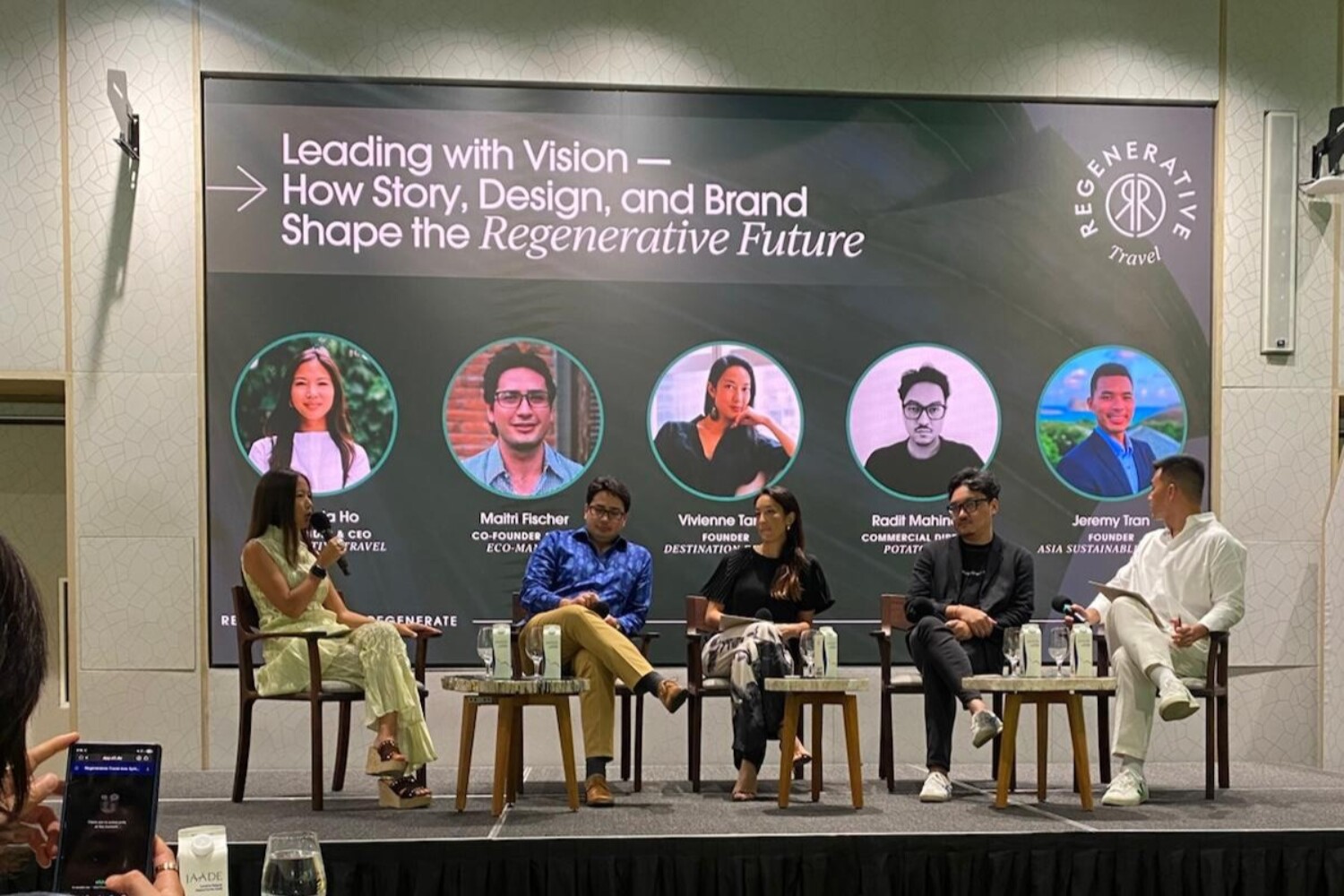
Singapore — June 28, 2026.
On June 28, 2026, Regenerative Travel hosted the Regenerative Travel Asia Symposium, bringing together hospitality operators, sustainability consultants, and journalists at the Mandai Rainforest Resort by Banyan Tree. A recurring issue across nearly every session was that the industry has yet to agree on the definition of “regenerative” or how to measure it.
This discrepancy was evident in the numbers as well. A live audience poll placed most attendees’ organizations between “extractive” and “neutral” on a three-point scale that also included “regenerative.” The discrepancy between where the industry claims to be heading and its current position was mentioned more than once.
Founder Amanda Ho opened the day by framing regeneration as an active commitment to restoring both nature and communities. Keynote speaker Juliet Kinsman followed with statistics: According to IRENA’s latest cost report, solar PV costs have fallen 89 percent since 2010, and new renewable capacity saved the global economy an estimated USD 480 billion in fossil fuel costs in 2025 alone. She paired that with a harder number to swallow: AI data centers now draw more electricity than most countries, and a UN University report released in June projects that their water footprint could match the basic domestic needs of over a billion people in sub-Saharan Africa by 2030. Kinsman also argued for replacing the word “destination” with “place” because it better reflects the communities that live there.
Several panelists used Bali as an example that everyone in the room understood: the island’s environmental capacity was outpaced by tourism growth years ago. They recommended assessing carrying capacity at the planning stage before approving the next development. We’ve made this point in our own carrying-capacity content, and hearing it repeated on a Singapore stage doesn’t change what still needs to happen locally.

Maitri Fischer participated in the opening panel, “Leading with Vision,” alongside Vivienne Tang of Destination Deluxe, Radit Mahindro of Potato Head, and Jeremy Tran of Sainha and Asia Sustainable Travel. The panel was moderated by Amanda Ho. Fischer presented data on the lifecycle costs of regenerative hotel projects, which she said typically recover their investment within seven to fourteen years. The second panel, “Breaking Ground,” covered implementation and was moderated by Juliet Kinsman. Panelists included Neil Jacobs of Wild Origins (former CEO of Six Senses Hotels Resorts), Melita Koulmandas of Song Saa Collective and Saracen Sanctuaries, Arnaud Girodon of Datai Hotels & Resorts, and Nicholas Hardman of Banyan Group. They discussed coral restoration, staff education, and local sourcing programs already in place at their properties.
Most of the practical examples that were shared did not require large capital outlays. Staff training, local sourcing, and community partnerships were mentioned more often than major retrofits. Certification and transparent reporting were the main defenses raised against greenwashing. This aligns with our internal approach to certification, which is mainly useful as a market-access baseline.
Attendees closed the day by committing to specific actions over the next 90 days, most of which are centered on staff engagement and having more candid internal conversations about where their properties actually stand. Whether these actions will result in measurable change by the next symposium remains to be seen.
Reporting via Travel Daily News Asia.