
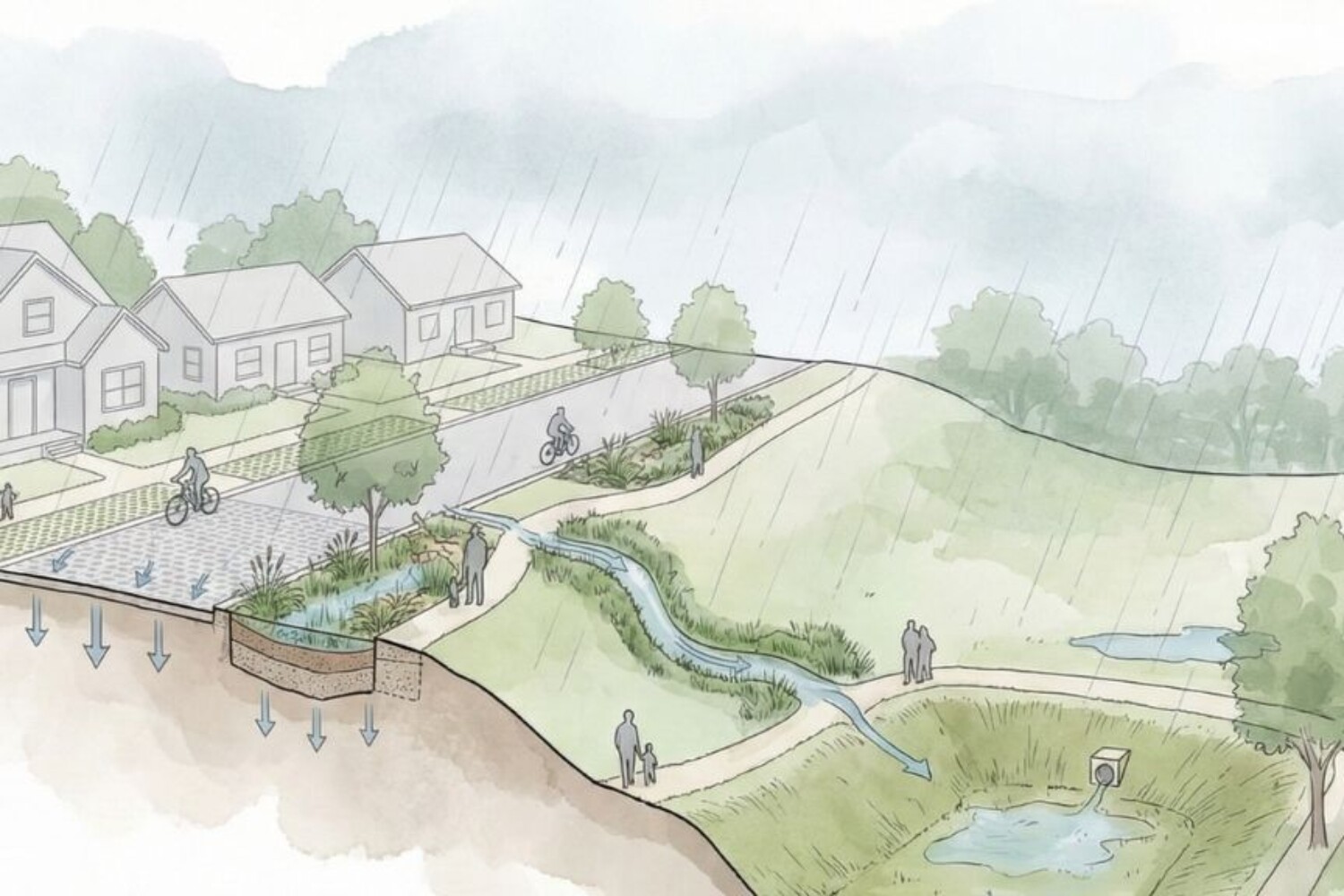
Current practice developers have long treated water as two separate conversations: how it looks, and how it drains. A lap pool framed by rainforest. Concrete channels running quietly beneath the villas. A pipe-and-drain system borrowed from the last project, replicated without question. In 2026, that approach carries real risk across financial, environmental, and brand reputation.
Climate patterns are intensifying. Regulators in Indonesia and across Southeast Asia are tightening green building requirements. And the ultra-high-net-worth guests that luxury resorts serve are increasingly choosing experiences that reflect their values, including environmental responsibility.
Sustainable stormwater management is no longer a compliance checkbox. It is one of the highest-leverage decisions you can make in resort development, shaping flood risk, operating costs, biodiversity, water reuse, and how your brand is perceived by guests, partners, and potential buyers of the asset.
01 — Conveyance: Moving Water Smarter, Not Just Faster
The conventional approach to stormwater conveyance is simple: get the water off the site as quickly as possible. Concrete channels, large-bore pipes, fast-drain systems. It works well enough, until it doesn’t. When rainfall intensity exceeds design capacity, fast-drain systems overwhelm downstream infrastructure, cause erosion, and send contaminated runoff directly into rivers, coastal waters, and the natural systems surrounding your resort.
Modern conveyance systems think differently. Rather than maximizing speed, they aim to slow, guide, and distribute water through the landscape. Vegetated swales, check dams, and naturalized channels move stormwater while simultaneously filtering sediment, creating habitat, and contributing to the visual landscape of the resort.
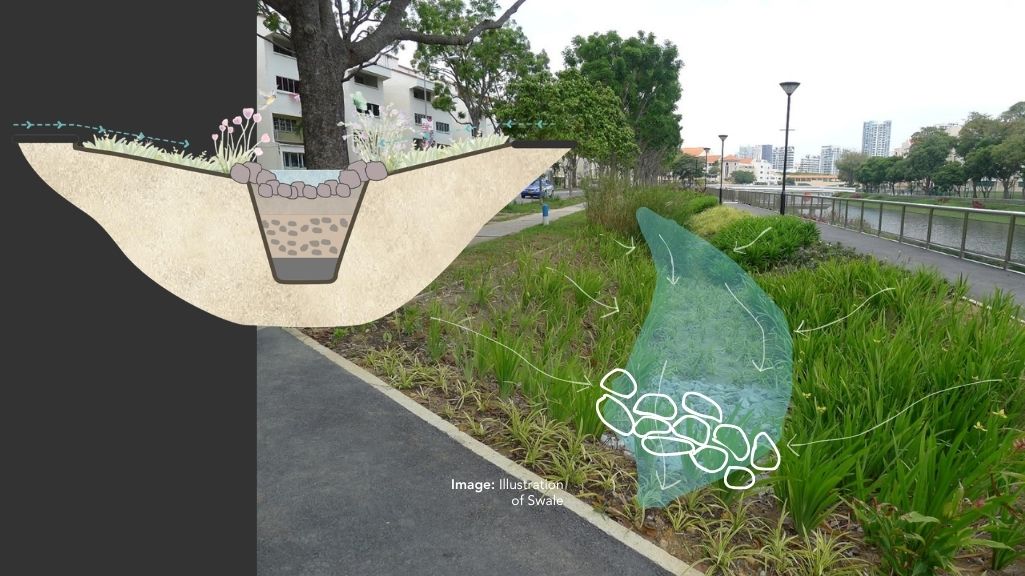
Singapore’s ABC Waters Programme (Active, Beautiful, Clean) is arguably the most cited global example of this shift. What was once a grey concrete drainage canal through Kallang River was transformed into a living, blue-green corridor integrated into the city’s park network. Residents now recreate alongside it. Property values increased. Ecological function was restored.
For resort developers, this is directly applicable. Conveyance infrastructure doesn’t have to be hidden or purely functional. Designed well, it becomes an experience: a creek path, a garden channel, a water feature that guests photograph.
Key Question
Are your drainage channels an eyesore or an amenity? In a high-end development, every square metre of infrastructure should be earning its keep both functionally and experientially.
02 — Detention: Buying Time for the System
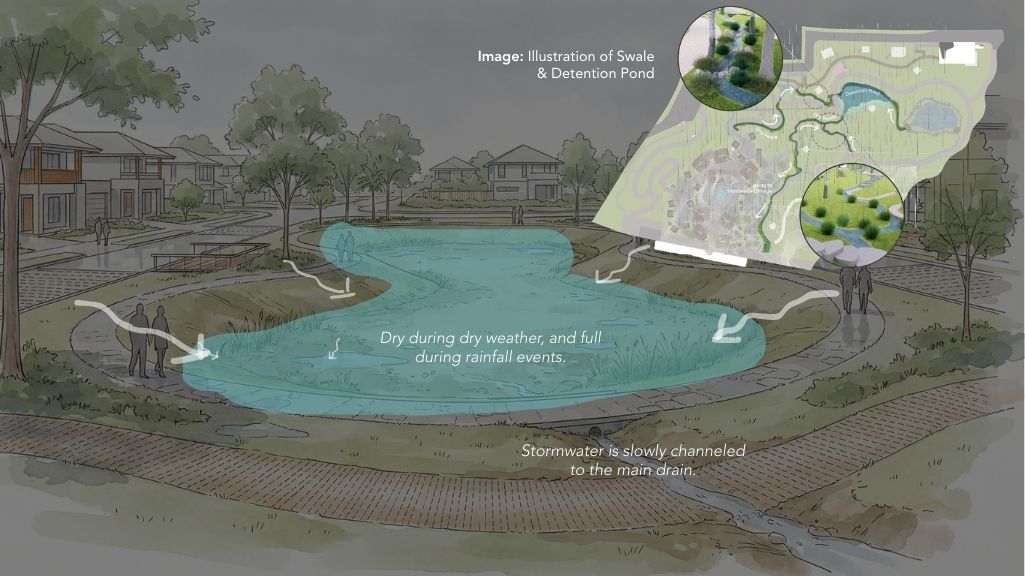
Detention is about time, not volume. The goal is to temporarily hold stormwater during peak rainfall events, flattening the hydrograph, so that downstream systems including rivers, municipal drains, and coastal zones are not overwhelmed all at once.
Think of it as a buffer. A detention basin fills during an intense downpour and then slowly releases water into the drainage system over the following hours or days. During dry periods, the basin sits empty, ready to be repurposed as a park, a lawn, or a recreational area.
For luxury resort development in tropical climates, detention is often non-negotiable. Indonesia receives between 2,000–4,000 mm of annual rainfall in many regions, and increasingly, that rainfall arrives in intense, concentrated bursts. Without adequate detention capacity, resort grounds, and in some cases guest villas, flood.
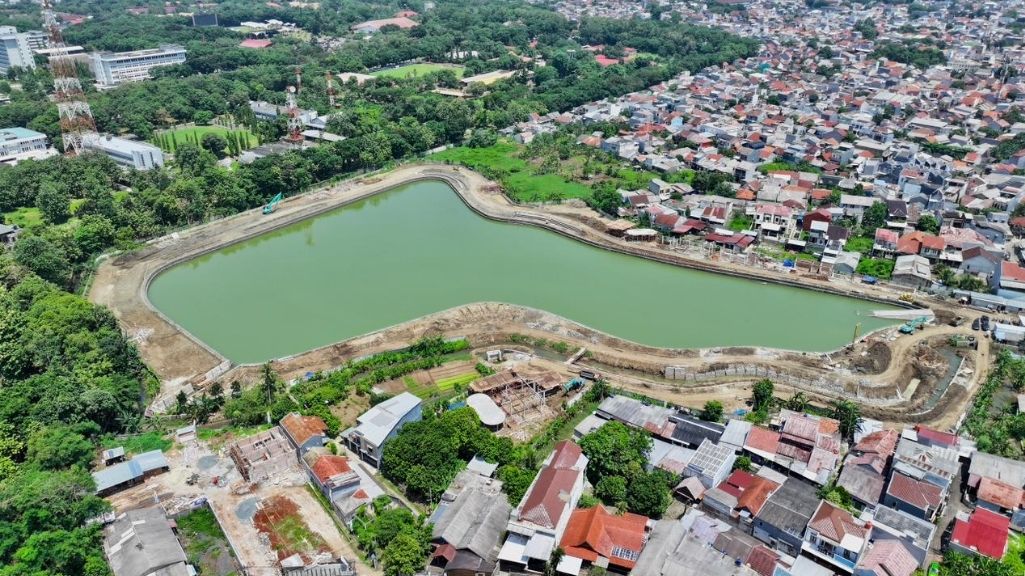
But well-designed detention doesn’t look like a liability. A resort pond doubles as a landscape centrepiece. Guests see a serene body of water surrounded by lush planting. Engineers see a detention basin with a controlled outlet structure. The best designs make these two readings inseparable.
Risk Note
Under-designing detention capacity is one of the most common and costly mistakes in tropical resort development. Flooding events damage infrastructure, disrupt operations, and in the age of social media, become a reputational crisis within hours.
03 — Retention: Keeping Water on Site as a Resource
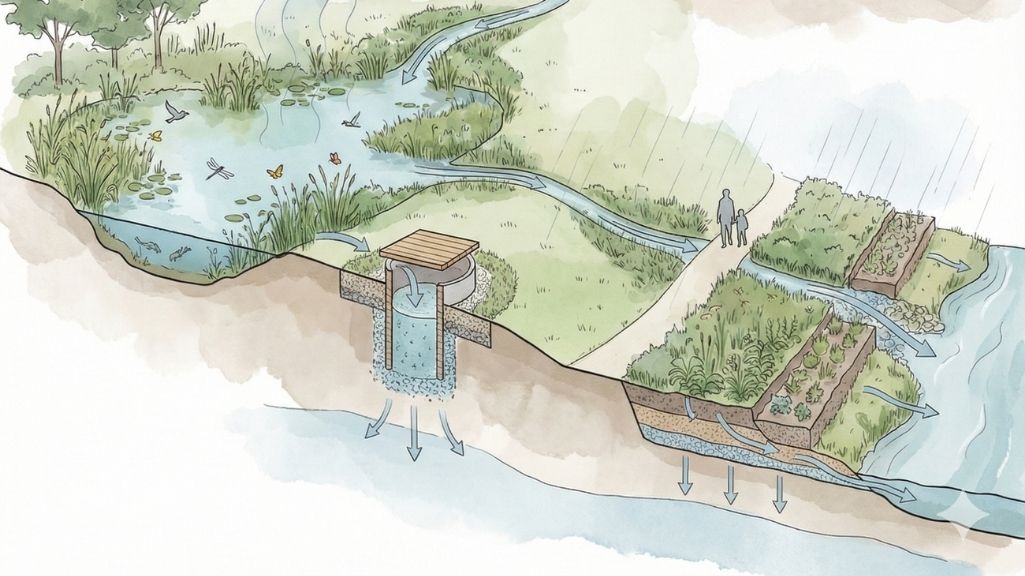
Where detention temporarily holds water before releasing it, retention keeps water on-site for significantly longer periods. Water retained in ponds, wetlands, or subsurface storage systems is gradually lost through infiltration into groundwater, evaporation, and plant uptake.
This distinction matters enormously for tropical resorts with significant irrigation demands. A resort with mature landscaping, golf greens, or extensive planting can consume thousands of cubic metres of water per month. If that demand is met by groundwater extraction or treated municipal supply, operational costs are high and environmental impact is significant.
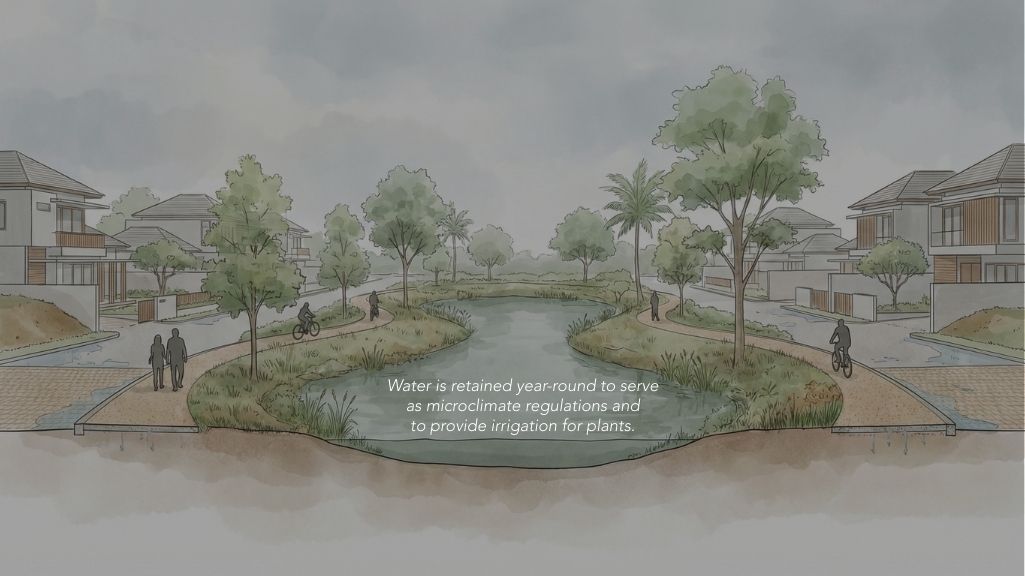
Retention systems turn stormwater into a resource. Rainwater collected during the wet season is retained on-site and drawn down through the dry season to irrigate planting, top up pools, or flush toilets. The Waduk Cilangkap reservoir concept in East Jakarta demonstrates this at scale, supporting urban microclimate regulation and irrigation year-round.
For luxury resorts, retention also has a compelling brand dimension. Water self-sufficiency is a story worth telling. A resort that can demonstrate it sources 70–80% of its non-potable water needs from retained rainwater is operationally efficient, a more defensible asset, and carries a more credible sustainability claim.
Asset Value Lens
Water retention infrastructure directly reduces long-term operational expenditure. For buyers and investors underwriting resort assets, this translates to improved NOI and lower risk — not simply an environmental credential.
04 — Infiltration: Recharging What You’ve Taken
Infiltration is the process of allowing stormwater to percolate through the soil and recharge the groundwater aquifer below. In coastal and tropical regions where groundwater is the primary source of freshwater, infiltration is a critical function that conventional impermeable surfaces eliminate entirely.
When a resort site replaces permeable forest or agricultural land with hardscaped surfaces, it dramatically reduces the rate at which rainfall reaches the aquifer. Over time, this contributes to groundwater depletion, a growing crisis across Bali, Java, and other high-development regions of Indonesia.
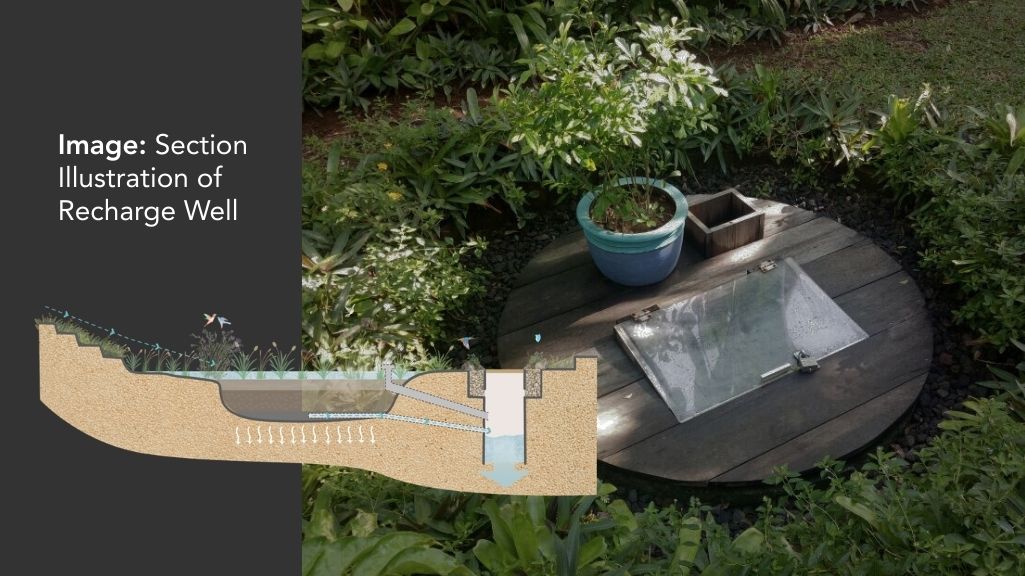
Infiltration infrastructure including recharge wells, bioretention basins, and permeable paving actively returns water to the system. What was once a problem (water on the surface) becomes a contribution (water in the aquifer).
There is also a regulatory dimension emerging across Indonesia. Groundwater regulations in many regions now require new developments above a certain threshold to demonstrate net-positive or at least neutral impact on local aquifer levels.
Long-Term Risk
Groundwater depletion is a slow-moving crisis that hits abruptly. Resorts built in areas with declining water tables face rising extraction costs, potential supply disruption, and in coastal areas, saltwater intrusion. Infiltration is a responsible move — and a protective one.
05 — Filtration: Protecting Water Quality Downstream
Every surface your resort covers — from roads and carparks to rooftops and pathways — generates polluted runoff when it rains. Motor oil, fertilisers, pesticides, sediment, and hydrocarbons wash into your drainage system and if left unmanaged, into surrounding rivers, coastal waters, and coral reef systems.
For a luxury resort marketing itself on pristine natural surroundings, this is more than an environmental issue. It is a direct contradiction of the brand promise.
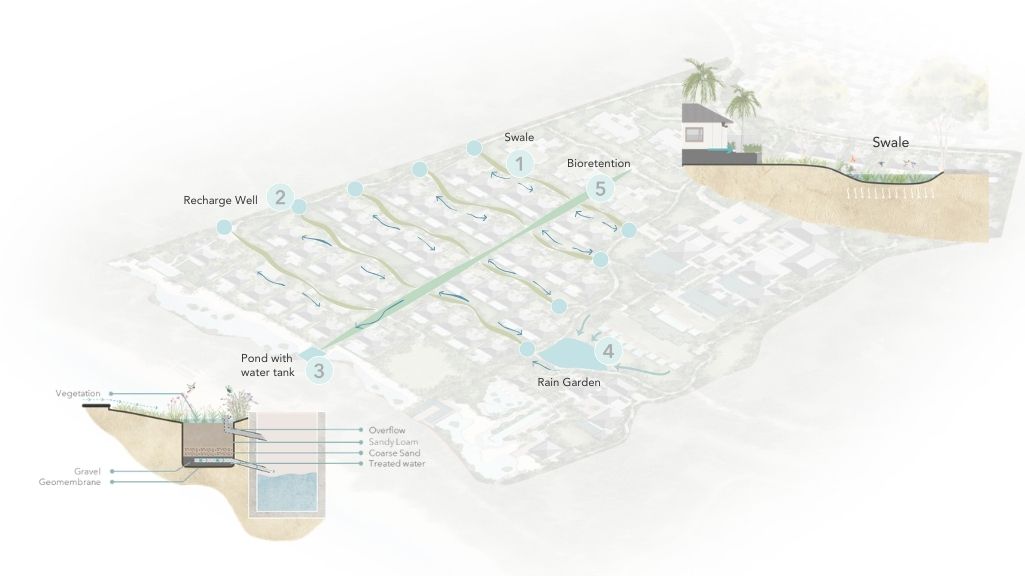
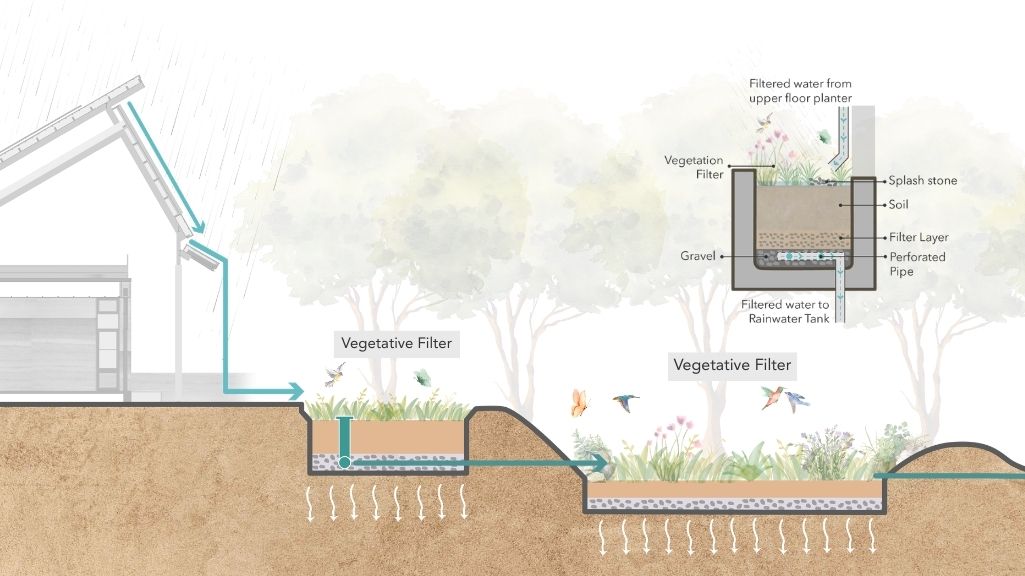
Filtration systems such as vegetative filters, bioretention cells, and constructed wetlands intercept pollutants before they reach water bodies. Layers of soil, sand, gravel, and plant root systems trap sediment, absorb nutrients, and allow biological breakdown of hydrocarbons. These systems process stormwater passively, with no energy input and minimal maintenance.
The most sophisticated resort designs integrate filtration into the landscape itself. A rain garden at the base of a carpark slope. A planted bioretention swale along a pathway edge. A constructed wetland framing the arrival sequence. These are design features with measurable ecological function, not environmental add-ons.
Brand Integrity
If your resort’s sustainability positioning includes marine or watershed conservation, you need to verify that your own stormwater is being filtered before it leaves the site. Green marketing without green infrastructure is a risk, not an opportunity.
The Strategic Case for Getting This Right
Stormwater management is not the most visible line in a resort development budget. But it may be one of the most consequential. It determines flood resilience. It shapes water costs for decades. It defines the environmental credibility of your sustainability commitments.
The developers who are winning in the luxury hospitality sector right now are building beautiful environments and resilient ones. In the era of climate risk and ESG scrutiny, the phrase “environmentally responsible” needs infrastructure behind it, not just intent.
Sustainable stormwater management for luxury resorts is not a green add-on. It is a core design discipline. The developers who treat it that way — investing in integrated, nature-based water systems from the earliest stages of planning — will build assets that are more resilient, more valuable, and better aligned with where the market is going.
What the Design Process Teaches Us
Four lessons from integrated stormwater projects across the region.
Lesson 01 Integration Drives Value
The most impactful systems are not single-purpose. A swale conveys and filters. A retention pond stores, cools the microclimate, and provides habitat. Systems combining multiple functions consistently outperform single-purpose infrastructure across financial, environmental, and experiential dimensions.
Lesson 02 Front-Load Investment in Planning
Comprehensive site assessment, soil testing, hydrological modelling, and stakeholder engagement in early project phases are the highest-return investments in the entire development budget. Design errors caught at concept stage cost fractions of what they cost to correct during construction.
Lesson 03 Secure Long-Term Maintenance Funding
The most common reason stormwater systems fail is poor maintenance, not poor design. A well-designed system that receives no maintenance degrades into a liability within a few years. Build maintenance into asset management protocols from day one.
Lesson 04 Local Context Cannot Be Copied and Pasted
Stormwater management in Indonesia is not the same problem as Singapore, Australia, or the Netherlands. Soil conditions, rainfall patterns, groundwater depths, regulatory frameworks, and construction capacity all differ significantly. Experienced local consultants are a prerequisite, not a luxury.
Ready to design water infrastructure that performs?