

A guide for hospitality developers and operators across Southeast Asia.
Introduction
The certification question now arrives early in almost every hospitality development conversation across Southeast Asia. Lenders raise it in due diligence, brand operators are starting to require it in their management agreements, and the booking platforms now let guests filter for certified properties directly. The difficulty is that “sustainability certification” is not one thing. The schemes split by what they actually assess: the design and construction of the building, the way it is run once it opens, or the company behind the hotel and whether its climate targets hold up. Choosing well means knowing which of those your project needs to answer, and for whom.
This guide maps the certifications that matter for hotels and resorts in Southeast Asia, what each one measures, and when each is the right choice, with a closer look at the Indonesian and Balinese market we work in most. Eco-Mantra is an environmentally sustainable design and engineering consultancy for hospitality, tourism, and resort developments in Indonesia, and these are the schemes we work with on client projects.
Key Takeaways
- There are three kinds of hotel certification: ones for the building (LEED, EDGE, Green Mark, Greenship, GBI), ones for how the hotel is run (EarthCheck, Green Globe, Green Key), and ones for the company behind it (B Corp, and science-based targets through SBTi). The Living Building Challenge is the most demanding of all, the regenerative top tier.
- GSTC does not certify hotels itself. It sets the rules that trustworthy operational schemes follow, so a “GSTC-recognized” label is a quick way to check that one is credible.
- Which one you need depends on who funds the project, which brand runs it, and the market it is in. Most hotels end up needing more than one, for example, a building certification plus an operational one.
- The top tier is rarely worth the money. A good mid-level certification usually gives you most of the benefits for far less cost.
- A certificate only shows you met the standard on the day you were checked, and the standard keeps getting stricter. A building sustainable enough to just pass today can fall behind within a few years.
What is hotel sustainability certification?
Hotel sustainability certification is a third-party verification that a property or the company that runs it meets a defined environmental or social standard. An independent body assesses against published criteria, then awards a rating or validation.
Three things can be certified, and they are often confused:
- The building. Its design and construction. Usually earned once.
- The operation. How the property runs after opening. Re-audited on a cycle.
- The organization. The company’s overall social and environmental performance, and whether its climate targets stand up to scrutiny.
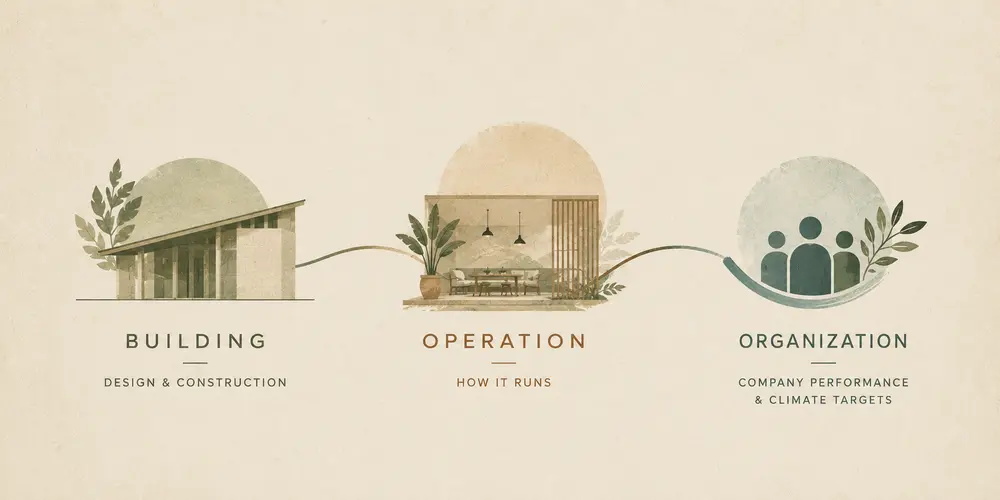
A single property can hold certifications across all three layers, and the most credible operators increasingly do.
Why does it matter for hospitality and resort development?
Certification has moved from a marketing extra toward a commercial requirement, for three practical reasons.
#1 Capital. Global private debt financing for green buildings rose roughly twentyfold, from about USD 10 billion in 2017 to around USD 230 billion in 2021, according to the IFC’s Building Green report. Green-labelled finance increasingly expects green-verified assets.
#2 Demand. Booking.com’s 2026 Travel & Sustainability Report recorded 100 million room nights booked at third-party certified properties in 2025, across 28,000 certified listings, up 22 percent year on year. The platform also retired its own self-declared sustainability badge in favour of third-party certification, which raises the bar for what counts as a credible claim.
#3 Asset value. Energy regulations are tightening on published schedules in most major markets. A building designed only to clear today’s threshold becomes harder to finance, insure, and sell as that threshold rises. The industry term for an asset that can no longer meet the standard is a stranded asset.
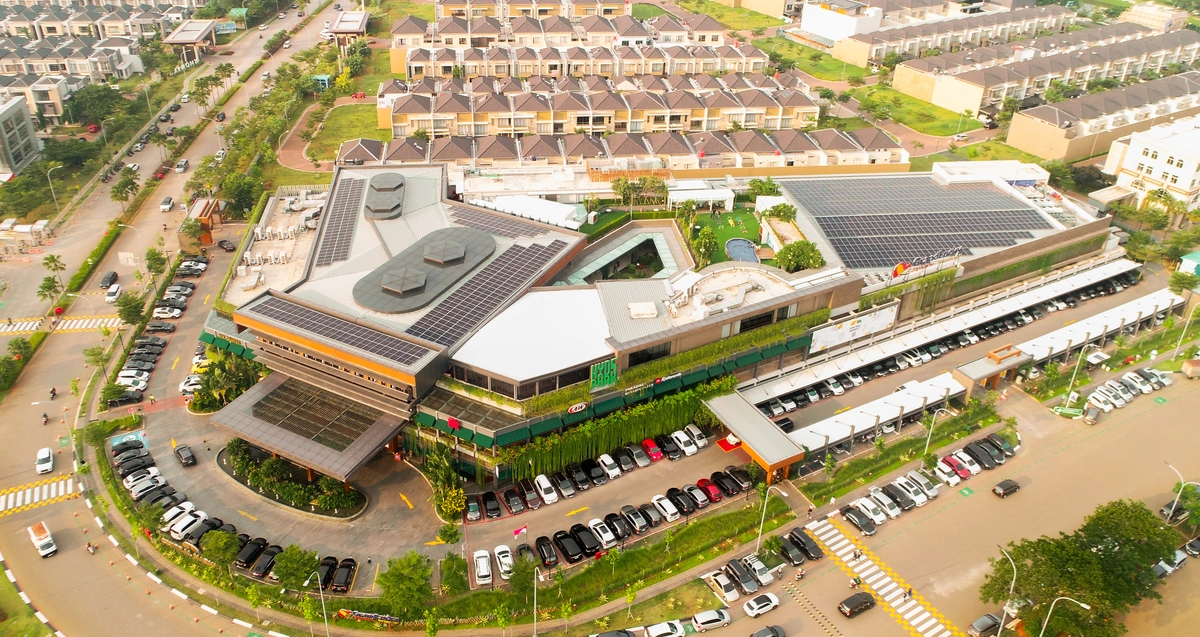
For a resort or hotel developer anywhere in Southeast Asia, certification is increasingly a condition of financing, branding, and resale.
The three layers of certification
| Layer | What it certifies | Examples | Earned or renewed |
| Building | Design and construction of the asset | LEED, EDGE, Green Mark, Greenship, GBI; Living Building Challenge (regenerative) | Usually once; the Living Building Challenge is verified over 12 months of operation |
| Operation | How the property runs day to day | EarthCheck, Green Globe, Green Key | Re-audited annually |
| Organization | The company’s social and environmental performance and climate targets | B Corp, SBTi-validated targets | B Corp recertifies; SBTi targets are time-bound |
Layer 1: Building certifications
These tell a financier or brand operator that the asset was designed and built to a standard.
| Certification | Origin | What it rates | Best fit for |
| LEED | US Green Building Council | Energy, water, materials, indoor air quality | International hotel brands and cross-border capital. Used in 160+ countries and territories. |
| EDGE | IFC, World Bank Group | Energy, water, embodied energy (min. ~20% savings each) | Projects needing a fast, lender-legible certification. Built for emerging markets; used in close to 140 countries. |
| Green Mark | Singapore BCA (since 2005) | Energy and water efficiency, indoor quality | Projects in or near Singapore, or wanting a standard designed for tropical climates. |
| Greenship | Green Building Council Indonesia | Core areas, adapted to Indonesian rules, climate, materials | Projects whose approvals and financing are mostly Indonesian. |
| GBI | Green Building Index (Malaysia) | Localized equivalent of the international standards | Malaysian projects. |
| Living Building Challenge | International Living Future Institute (ILFI) | Net-positive energy and water, materials free of the Red List, and place, judged across seven ‘Petals’ and verified over 12 months of real operation | Flagship and regenerative projects aiming beyond conventional certification; the most demanding standard available. |
EDGE, created by the IFC, is the quickest and most lender-legible option in emerging markets. LEED is the most widely recognised internationally and is what most global hotel brands and cross-border investors already know. Green Mark and Greenship were built for tropical conditions and local regulation, which matters across Southeast Asia’s climate.
The Living Building Challenge sits above the rest of this list, and it works differently from the others. Run by the International Living Future Institute, it asks a building to give back more than it takes. A Living Building has to generate more energy on site than it uses and treat more water than it consumes, and it has to avoid a defined Red List of harmful materials. Performance is judged across seven areas, called Petals, and certification is awarded only after the building has run for twelve continuous months and proven those results in operation, not on design models. Very few buildings worldwide have met it in full, so for most hotel and resort projects it works as a regenerative benchmark rather than a routine target. It shows what a building can do when it is designed purely for performance, and it is where our regenerative design work aims, even on projects that pursue a more conventional certification in the end.
Layer 2: Operational certifications
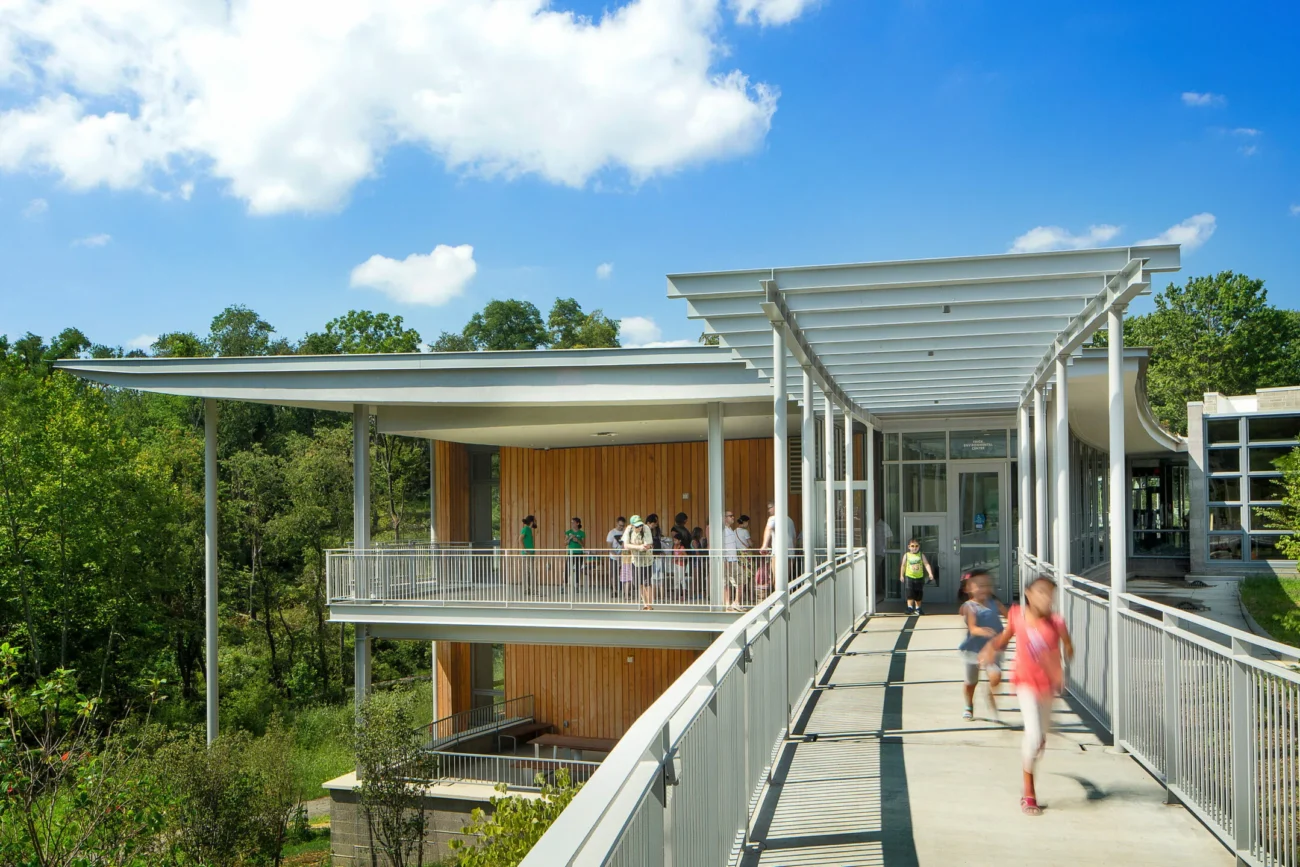
These verify how the hotel runs after opening, and are re-audited every year, so they can be lost if performance slips.
| Certification | Origin | What it rates | Best fit for |
| EarthCheck | Australia; a science-based benchmarking and certification group for travel and tourism | Operational performance benchmarked year on year: energy, water, waste, carbon, suppliers, community | Established hotels and resorts that want to prove measured results. Strong across Asia Pacific, and GSTC-recognized. |
| Green Globe | International; head office in Los Angeles | Sustainable operation and management across 44 criteria spanning management, social and economic, cultural, and environmental performance | Hotels and resorts wanting a widely recognized operational mark with annual auditing. GSTC-recognized. |
| Green Key | Foundation for Environmental Education (FEE), a non-profit based in Denmark | Day-to-day environmental management of a tourism property, verified through documentation and on-site audits | Smaller and independent hotels that want a credible, internationally known eco-label. |
GSTC (Global Sustainable Tourism Council) sits above this layer. It does not certify hotels directly. It writes the global standard that credible operational certifications are measured against, so a “GSTC-recognized” label is a reliable signal when you compare them.
Layer 3: Organizational and climate certifications
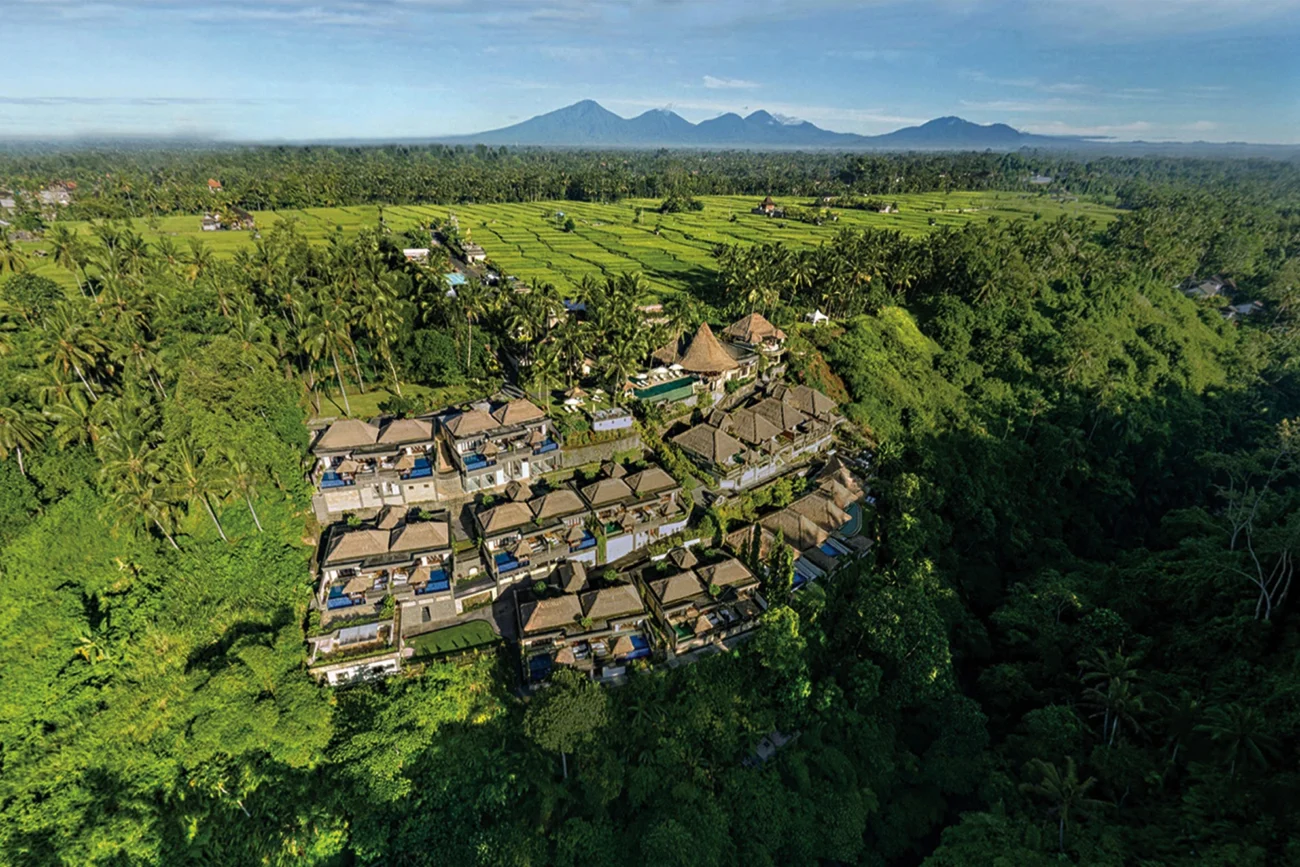
This layer rates the business, not a single building or its day-to-day operation. It is where sustainability claims are now scrutinised hardest, and where Southeast Asian operators are starting to lead.
| Certification | Origin | What it rates | Best fit for |
| B Corp | B Lab, a non-profit founded in 2006 | The whole company’s social and environmental performance across governance, workers, community, environment, and customers. Requires a verified minimum score and periodic recertification | Operators wanting to certify the business behind the hotel, not just the asset or how it runs |
| SBTi | Science Based Targets initiative, a partnership of CDP, the UN Global Compact, WRI, and WWF | Whether a company’s emissions-reduction targets align with climate science. Requires a full Scope 1, 2, and 3 inventory and a credible reduction plan | Operators committing to a credible, time-bound decarbonization trajectory, often toward net zero |
Both depend on work that sits beneath the certificate: a carbon assessment to measure the footprint, and a decarbonization roadmap to reduce it. What makes the target credible is that underlying measurement and plan. The certificate records it.
Indonesia and Bali in focus
We are based in Bali, so a note on the local picture is worth including, both as context and as a measure of how early the market still is.
Adoption in Indonesia is still in its early stages, which is both the gap and the opportunity. According to the Green Building Council Indonesia, about 5 percent of the country’s roughly 4,000 developers (around 200) have committed to green certification, and 504 buildings nationwide held Greenship certification as of April 2026. Very few of those are hospitality assets.
Regulation is closing the gap. Ministry of Public Works regulation No. 21 of 2021 ties green building performance assessment to Building Approval (PBG) and the Certificate of Functional Worthiness (SLF), which moves certification toward a compliance baseline rather than a voluntary badge.
For Bali hospitality specifically, the tropical climate favours schemes designed for it, including Green Mark, EDGE, and Greenship. With so few certified hospitality assets in the market, a credibly certified resort still stands apart, and that advantage should hold for several more development cycles.
Common mistakes
- Treating the certificate as the goal. Certification is an output of good engineering. Pursued on its own, it adds cost without changing how the building or business performs.
- Chasing the highest tier. The top rating costs noticeably more, and the marginal points often do not pay back.
- Bringing certification in late. Once the design is locked, the building has to be reworked to pass, which is the most expensive way to certify.
- Confusing the three layers. A building certification does not prove good operations, and neither proves the company has credible climate targets. Each layer answers a different question.
- Relying on self-declared claims. “Eco-friendly” language with no third-party verification now carries little weight, a shift signalled by Booking.com retiring its own self-reported badge.
- Forgetting renewal. Operational certifications are re-audited annually, B Corp requires recertification, and science-based targets are time-bound.
Best practices
- Confirm the requirement first. Find out what your lenders and brand operator actually need before choosing a scheme. This avoids redoing work later.
- Design for performance, not for points. Use the site, the sun, airflow, and water properly. A building that performs earns certification with little extra effort and holds it as standards tighten.
- Choose the tier that pays back. A solid mid-level certification usually captures most of the value. Reserve the top tier for cases where a lender or brand specifically requires it.
- Measure before you certify. A carbon assessment across Scopes 1, 2, and 3 is the basis for any credible organizational or climate certification, and it tells you where reductions are cheapest.
- Cost every decision. Pair each sustainability recommendation with a lifecycle cost assessment, so the capital and operating implications are clear before you commit.
- Plan for renewal. Build the audit and target-review cycle into operations from the start.
Case studies: how Waterbom and Potato Head were certified by performing first
On both projects below, the result showed up in operating numbers and validated targets before it showed up as a certificate.
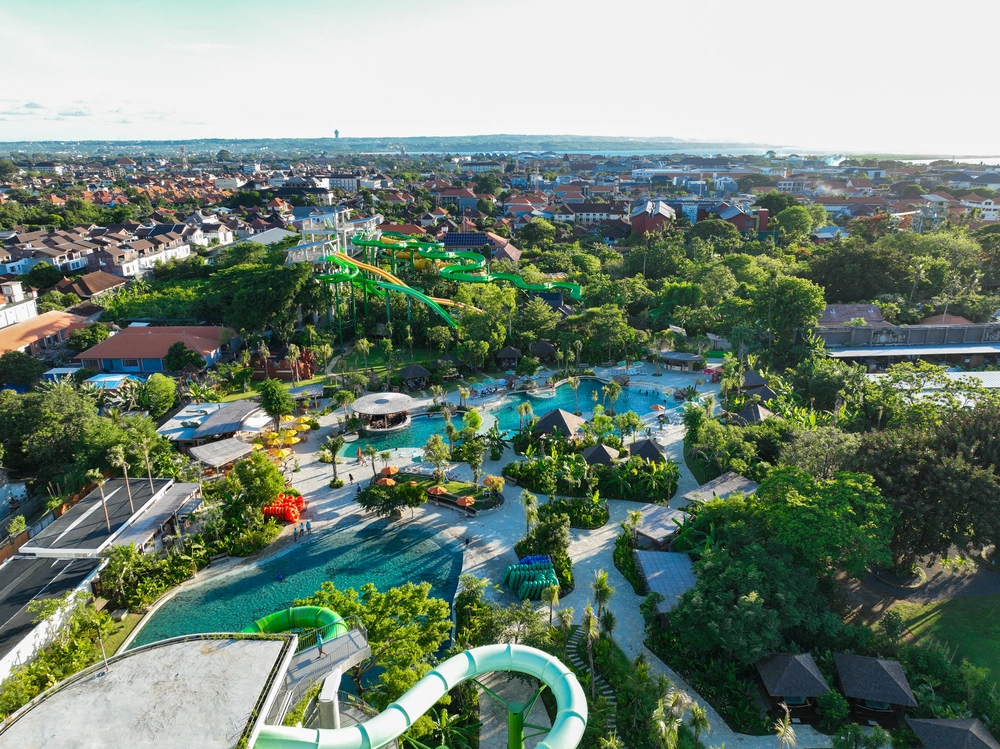
Waterbom Bali has worked with Eco-Mantra on its sustainability program since 2016. In that time the park became the first tourism business in Indonesia to have its near-term emissions-reduction targets approved by the Science Based Targets initiative, committing to cut 100% of Scope 1, 2, and 3 emissions by 2033 in line with the Paris Agreement. On the operational side, the park reported sending just 1.2 percent of its waste to landfill in the first quarter of 2025, with the rest recycled or composted, and it has held EarthCheck certification in 2016, reaching Gold. The science-based target sits on a full carbon assessment and a decarbonization roadmap covering energy reduction, renewable supply, and supply-chain measures, which Eco-Mantra developed with the park’s team.
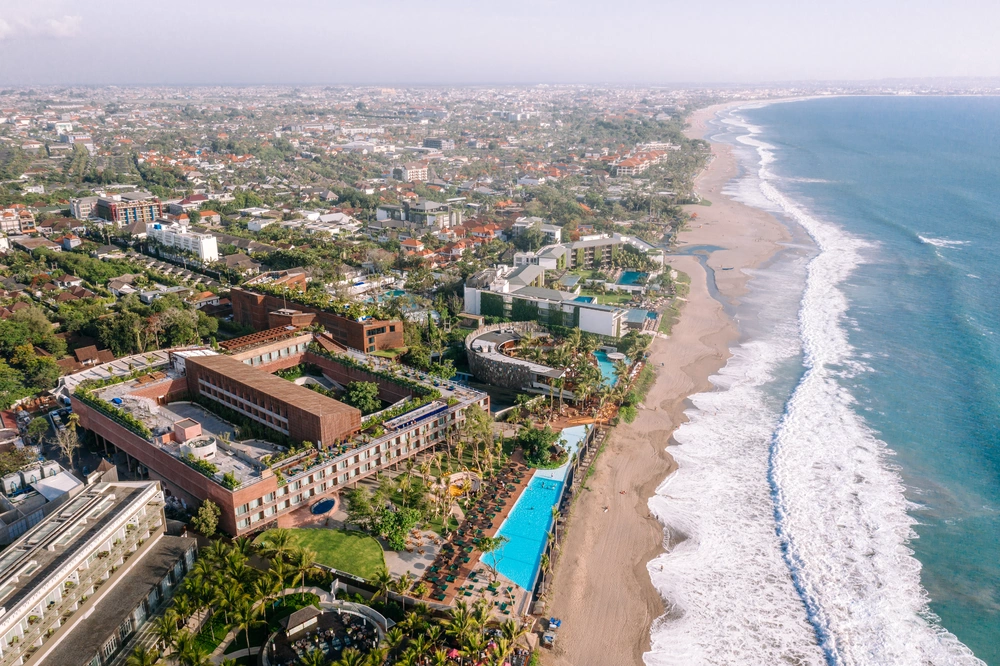
Desa Potato Head Bali sits in the same organisational layer, certified as a B Corporation with a verified B Impact score of 81.7, well above the median for assessed businesses. Its certification rests on measured operational results, including a deep cut in landfill waste over several years.
The pattern in both cases is the same. The properties were designed and run to perform first. The certification then recorded results the operation had already reached.
Expert perspective from Eco-Mantra
We help clients get certified, and that is part of the work. Most of it sits with the building, where we support LEED, EDGE, Green Mark, and Greenship, because the design decisions made early are what determine how easily a project passes. We also support the operational side that EarthCheck, Green Globe, and Green Key assess, and the carbon assessment and decarbonization roadmap that B Corp and SBTi rely on.
But the certificate is not the objective. The real work is designing the building to perform from the start, using orientation, shading, natural ventilation, and water strategy to cut energy and water demand at source. That is where most of the outcome is decided. The same discipline carries into operations and into the company’s wider footprint: when waste, water, and energy systems are designed into how the hotel is run, an operational certification such as EarthCheck mostly records results the property already reaches. Do that, and certification comes more easily and stays easier as the rules tighten. Going for the highest tier is not automatically the right call either, because the extra cost frequently stops paying off. Every recommendation we make is paired with a lifecycle cost assessment, so the capital and operating cost of each option is on the table before anyone commits to a tier.
Frequently Asked Questions
It depends on the project’s lenders, brand operator, and market, and on which layer you need to address. EDGE suits projects needing a fast, lender-legible building certification. LEED suits international brands and cross-border capital. Greenship and Green Mark fit local approvals and tropical conditions. EarthCheck verifies operations once the hotel is open. B Corp and SBTi address the company and its climate targets. Many operators use more than one.
All three are building certifications. LEED (US) is the most internationally recognized. EDGE (IFC, World Bank) is the fastest and was built for emerging markets and lenders. Greenship (Green Building Council Indonesia) is adapted to Indonesian regulation, climate, and materials.
Operational certifications rate how a hotel is run, not how it was built. EarthCheck and Green Globe are the established names across Asia Pacific, and both are GSTC-recognized. Green Key suits smaller, independent hotels. All three are re-audited every year, so they reflect how the property performs now, not a one-time result.
It is the most rigorous green building standard, run by the International Living Future Institute. A Living Building has to make more energy than it uses and treat more water than it consumes, and it must avoid a Red List of harmful materials, proven over twelve months of real operation.[10] Very few buildings worldwide have achieved it, so for hotels it works as a regenerative benchmark for flagship projects rather than a routine target.
Yes. B Corp certifies the company that runs the hotel, not the building. B Lab assesses the whole business across governance, workers, community, environment, and customers, and the company has to clear a verified minimum score and recertify over time. Desa Potato Head Bali is a certified B Corporation.[8]
Building certifications are generally earned once for the design and construction. Operational certifications such as EarthCheck and Green Key are re-audited annually. B Corp requires recertification, and science-based targets are time-bound and reviewed.
GSTC (Global Sustainable Tourism Council) sets the global standard for sustainable tourism. It does not certify hotels itself. It defines the rules that credible operational certifications follow, so a “GSTC-recognized” label tells you a scheme meets that standard.
No. Booking.com retired its self-declared “Travel Sustainable” badge and now displays third-party certifications instead, which makes independent certification more important for visibility on the platform.[1]
Conclusion
There is no single right certification, and most hotels need more than one. A building certification like LEED, EDGE, Green Mark, or Greenship covers how the asset is built. An operational one like EarthCheck, Green Globe, or Green Key covers how it is run. B Corp and SBTi cover the company behind it, and the Living Building Challenge sits at the top for projects going further. Which ones you pursue comes down to who funds the project, which brand runs it, and the market it is in.
Whichever you choose, the process rewards starting early. Decide the targets before the design is locked, confirm what your lenders and brand operator require, run a carbon assessment where an organisational or climate certification is in play, and budget for the renewals on the operational ones. Certification brought in late means reworking a building to pass, which is the slow and expensive way to get there.
The standard you are measured against keeps tightening, so the decision worth making early is how far ahead of it you want the asset to sit. A building designed and run to perform tends to stay there on its own, and the certification ends up confirming what is already true.
Work with Eco-Mantra
Eco-Mantra engineers sustainability into hospitality, tourism, and resort developments, from first feasibility study through daily operations and corporate climate strategy.
- Discover & Plan. Sustainability strategy, feasibility studies, and environmental and baseline assessments to set the right certification path before design begins.
- Design & Build. Environmentally sustainable design, net-zero and regenerative resort design, and green building certification support across LEED, EDGE, Green Mark, and Greenship.
- Operate. Hotel decarbonisation, waste reduction, zero waste to landfill, carbon assessment, and the decarbonization roadmaps behind SBTi-validated targets and B Corp certification.